
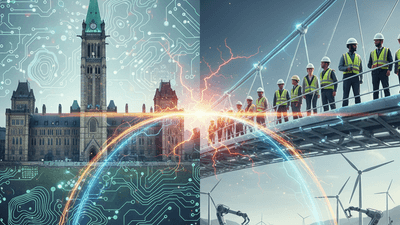



As the Canadian engineering community gathers this March to celebrate National Engineering Month 2026, the industry finds itself at a profound crossroads. While public events and webinars rightfully highlight the profession's contributions to building a better world, the reality on the ground is increasingly defined by a stark duality: the frustrating gridlock of traditional megaprojects versus the hyper-accelerated pace of clean technology and strategic defense initiatives. For engineering leaders, managing this bimodal reality is no longer just a strategic advantage—it is an absolute necessity.
This friction was thrust into the spotlight recently when Canadian Natural Resources Ltd. (CNRL) announced the delay of a massive, planned $8.25-billion mine expansion north of Fort McMurray. The culprit? Regulatory uncertainty surrounding carbon pricing and incoming methane emissions rules. As policy debates stall shovels in the ground, Canadian engineering firms are pivoting, finding momentum in agile R&D, grid modernization, and high-priority national defense projects.
The Megaproject Bottleneck: Regulatory Flux Halts $8.25B Expansion
The suspension of CNRL's Fort McMurray expansion is a bellwether for the heavy industrial sector. The project, which would have sustained thousands of engineering, procurement, and construction (EPC) jobs over the next decade, has been put on ice due to a lack of clarity on federal emissions caps and carbon pricing mechanisms. Local leaders have expressed deep frustration, emphasizing that the capital is available and the engineering designs are mature, but the regulatory foundation is too unstable to support an $8.25-billion investment.
"You cannot engineer a foundation on shifting sands. When the regulatory parameters for carbon and methane change quarter by quarter, the risk models for decade-long megaprojects simply break down."
For Canadian EPC firms, this represents a significant bottleneck. Teams that specialize in large-scale resource extraction and heavy civil works are seeing their project pipelines disrupted. The lesson here is clear: reliance on traditional resource megaprojects carries an increasingly high risk premium. Firms must adapt by either helping clients engineer their way out of emissions liabilities or by reallocating talent to sectors where funding and policy are actively aligned.
Agile Engineering: Innovating Around the Roadblocks
While macro-level policy stalls the largest projects, micro-level innovation is moving at breakneck speed. Engineers are bypassing regulatory friction by focusing on technological solutions that actively solve the emissions and infrastructure challenges policymakers are debating.
Electrifying the Fleet: MacLean Engineering
If building a new mine is delayed by emissions concerns, the immediate engineering pivot is to decarbonize the equipment used within existing operations. A prime example is MacLean Engineering, which recently secured $2.5 million in federal funding from Natural Resources Canada (NRCan). This investment is accelerating the commercialization of their GR8 EV Grader, a battery-electric vehicle (BEV) designed specifically for the mining sector.
By focusing on clean technology product development, MacLean is effectively insulating itself from the regulatory delays plaguing site-level expansions. They are providing the very tools that operators like CNRL will need to meet future methane and carbon regulations, turning a regulatory hurdle into a lucrative engineering mandate.
Grid Simulation at Warp Speed: UBC Okanagan
Electrifying mining fleets and industrial operations places an unprecedented strain on regional power grids. Before a single physical cable is laid, engineers must guarantee grid stability. Here, academia is providing a crucial breakthrough. New research from UBC Okanagan's School of Engineering is dramatically speeding up the simulations used to test high-voltage electricity systems.
As power grids integrate massive renewable energy inputs and large-scale battery storage, the mathematical complexity of grid simulation grows exponentially. The UBC Okanagan advancements allow electrical engineers to test vastly more scenarios in a fraction of the time, identifying catastrophic risks long before physical integration. This digital-first approach to infrastructure engineering is becoming a mandatory capability for firms looking to win contracts in the utility and power distribution sectors.
Strategic Infrastructure: The Exception to the Rule
While resource megaprojects face regulatory headwinds, strategic government infrastructure—particularly in defense—operates on a completely different timeline and mandate. The geopolitical realities of 2026 have made Arctic sovereignty a paramount concern, bypassing traditional red tape.
Recently, Stantec was selected by Defence Construction Canada to deliver multidisciplinary engineering and design services for the first phase of Canada's Arctic Over-the-Horizon Radar (A-OTHR) project. With a validation phase commencing in Q1 2026, this project demands a staggering breadth of engineering disciplines: geotechnical engineering for permafrost foundations, structural engineering for extreme wind and thermal loads, and advanced systems integration for the radar arrays.
Projects like A-OTHR highlight a critical opportunity for large-scale engineering firms. By maintaining the capacity to execute highly complex, multidisciplinary projects in extreme environments, firms can secure long-term, government-backed contracts that are immune to the carbon-pricing debates stalling the private resource sector.
Adapting Firm Strategy in a Bimodal Market
To navigate this landscape, Canadian engineering firms must adopt a highly adaptable operational strategy. The contrast between stalled resource projects and booming green-tech/defense initiatives requires a fundamental rethinking of resource allocation.
| Project Category | Current Market Status | Primary Engineering Focus | Strategic Action for Firms |
|---|---|---|---|
| Traditional Resource Megaprojects | High Friction / Delayed (e.g., CNRL Expansion) | Heavy Civil, Traditional EPC, Process Engineering | Pivot to emissions-reduction retrofits and compliance engineering. |
| Clean Technology & R&D | Accelerating (e.g., MacLean EV Grader) | Mechanical, Electrical, Battery Integration | Pursue NRCan funding; partner with OEMs for rapid prototyping. |
| Grid & Digital Infrastructure | High Growth (e.g., UBC Grid Simulation) | Software, Electrical, Systems Modeling | Invest heavily in digital twin technology and predictive simulation. |
| Strategic Defense | Fast-Tracked (e.g., Stantec A-OTHR) | Geotechnical, Structural, Multidisciplinary | Develop specialized expertise in remote/Arctic project execution. |
Actionable Steps for Engineering Leaders
- Diversify Beyond Traditional EPC: Ensure your firm's revenue isn't tied solely to heavy resource extraction. Build out your environmental, social, and governance (ESG) compliance engineering arms.
- Invest in Digital Prototyping: Follow the lead of UBC Okanagan's research. The ability to simulate complex systems rapidly will win bids over firms relying on legacy modeling techniques.
- Target Government-Backed Strategic Assets: Defense and critical infrastructure projects are insulated from market and regulatory fluctuations. Position your firm for Defence Construction Canada (DCC) and infrastructure bank tenders.
Conclusion: Engineering the Path Forward
As National Engineering Month 2026 kicks off, the narrative surrounding the Canadian engineer is shifting. We are no longer just the builders of massive mines and highways; we are the navigators of complex regulatory landscapes, the architects of decarbonized grids, and the defenders of northern infrastructure. The delay of the $8.25-billion CNRL project is a stark reminder of the challenges we face, but the rapid advancements by MacLean Engineering, UBC Okanagan, and Stantec prove that when one door closes due to red tape, Canadian engineering ingenuity forces three more open.