
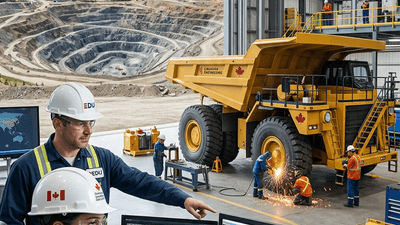



The true measure of an engineering powerhouse is found not just in what it builds within its own borders, but in the expertise and industrial capacity it exports to the world. For decades, Canada has been globally recognized for its vast natural resources and the sophisticated engineering required to extract them. Today, however, the paradigm is shifting. We are no longer just exporting commodities; we are exporting our engineering standards, management frameworks, and heavy manufacturing capabilities.
Two recent developments perfectly encapsulate this dual trajectory. In the academic and strategic sector, the federal government is funding the export of Canadian mining expertise to South America. Concurrently, in the industrial heartland, heavy equipment manufacturers are securing the working capital necessary to fulfill expanding global order books. Together, these moves signal a maturing Canadian engineering sector that is playing a highly strategic game on the world stage.
The Knowledge Export: U of T’s Global Mining Initiative
Canada's reputation in the global mining sector is unparalleled, but maintaining that leadership requires proactive engagement beyond our borders. Recently, Natural Resources Canada approved a highly strategic Minerals Skills Network Grant, directing nearly $1 million to the University of Toronto. The funding is earmarked for U of T’s Mining Industry Management Program to offer specialized online training and scholarships to mining professionals located in South America.
"By educating international professionals in Canadian frameworks of resource management, environmental stewardship, and operational efficiency, Canada is effectively standardizing global mining practices to align with our own domestic engineering principles."
Strategic Influence in South America's Resource Triangle
South America is ground zero for the critical minerals boom, housing the "Lithium Triangle" and some of the world's most productive copper reserves. However, rapid extraction demands sophisticated management to ensure environmental sustainability, safety, and operational efficiency. By providing this education, Canada is achieving several strategic objectives:
- Establishing Global Standards: Training international engineers in Canadian methodologies ensures that global projects are increasingly managed using frameworks familiar to Canadian consulting and engineering firms.
- Fostering Diplomatic and Economic Ties: Alumni of the U of T program will go on to lead major South American mining operations, creating a natural network of executives who are predisposed to partnering with Canadian technology and service providers.
- Elevating the Engineering Manager: The focus on management rather than purely technical extraction highlights a critical evolution. The modern mining engineer must be adept at ESG (Environmental, Social, and Governance) compliance, community relations, and complex supply chain logistics.
Fortifying the Industrial Base: Expanding Heavy Manufacturing
While U of T exports intellectual capital, Canada’s domestic manufacturing sector is ensuring it has the physical and financial capacity to meet growing industrial demands. In a move that highlights the ongoing revitalization of our heavy manufacturing base, Isgec Heavy Engineering's Canadian subsidiary, Eagle Press & Equipment Co. Ltd., has successfully secured a CAD 2 million Standby Letter of Credit.
Eagle Press, based in Windsor, Ontario, specializes in the design and manufacture of heavy mechanical and hydraulic presses used extensively in the automotive, aerospace, and appliance industries. In an era where supply chains are localizing and the automotive sector is undergoing a massive retooling for electric vehicles (EVs), the demand for heavy stamping and forming equipment is surging.
The Role of Working Capital in Manufacturing Readiness
To the layperson, a CAD 2 million credit facility might seem like standard corporate finance. To an industrial engineer or manufacturing plant manager, it represents something much more vital: agility. Working capital allows heavy manufacturers to:
- Procure Raw Materials Proactively: In a volatile steel and components market, having liquidity allows manufacturers to lock in material costs and avoid supply chain bottlenecks.
- Scale Workforce and Engineering Teams: Fulfilling new, complex orders requires ramping up engineering hours for custom press designs before the final product is delivered and paid for.
- Accelerate R&D Implementation: Modern heavy presses require integration with advanced robotics and IoT sensors. Working capital funds the integration of these smart technologies during the build phase.
This financial backing ensures that Canadian manufacturing facilities can aggressively bid on and execute large-scale global contracts without being constrained by cash flow limitations during the capital-intensive fabrication process.
Comparing the Investments: Intellectual vs. Physical Capital
To understand the full scope of how the Canadian engineering sector is scaling, it is useful to compare these two distinct, yet complementary, investments.
| Investment Focus | U of T Mining Grant ($1M) | Eagle Press Credit Facility (CAD 2M) |
|---|---|---|
| Sector | Mining & Resource Extraction | Heavy Industrial Manufacturing |
| Type of Capital | Intellectual & Human Capital | Financial & Physical Capital |
| Primary Beneficiary | International Professionals (South America) | Domestic Operations (Windsor, Ontario) |
| Strategic Engineering Goal | Exporting Canadian ESG and management standards globally. | Scaling domestic capacity to fulfill international equipment orders. |
Practical Implications for Canadian Engineering Professionals
The synergy between exporting knowledge and expanding domestic manufacturing capacity creates a dynamic environment for engineering professionals across the country. Here is what this means for your career and your firm:
- Global Consulting Opportunities: As Canadian mining standards become increasingly embedded in South American operations through programs like U of T's, Canadian consulting engineers will find a more receptive market for their services in the southern hemisphere. Familiarity with Canadian regulatory and safety frameworks will be a premium asset.
- The Shift Toward "Engineering Management": The U of T grant specifically targets the management of mining industries. Engineers who combine their technical acumen with formal training in finance, ESG reporting, and global supply chain logistics will command the highest market value in the coming decade.
- Revitalization of Mechanical and Manufacturing Engineering: The financial bolstering of companies like Eagle Press indicates a strong pipeline of orders for heavy machinery. Mechanical engineers, automation specialists, and industrial designers should look to the Windsor-to-Toronto corridor as a resurgent hub for advanced manufacturing, particularly tied to the EV transition.
Conclusion: A Dual Engine of Growth
The narrative of Canadian engineering is often dominated by domestic megaprojects—pipelines, transit systems, and power grids. However, as demonstrated by the federal backing of U of T’s global mining education and the financial scaling of heavy manufacturers like Eagle Press, our true strength lies in our ability to influence the global market. By exporting our intellectual capital to resource-rich regions and simultaneously fortifying our domestic industrial base, Canada is ensuring that its engineering sector remains not just relevant, but indispensable to the global economy of tomorrow.