
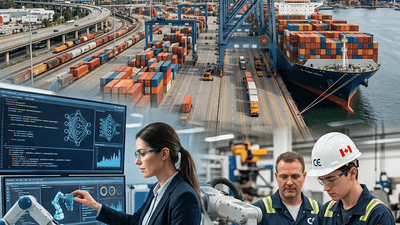



Canadian engineering in 2026 is defined by a fascinating dichotomy: we are simultaneously writing the algorithms that will decode human biology and pouring the concrete for the massive supply chains that will anchor our domestic economy. For engineering professionals, navigating this landscape requires an understanding of how theoretical breakthroughs, industrial-scale execution, and grassroots talent development are intersecting to push the industry forward.
Recent developments across the country—ranging from academic honours in Saskatchewan to massive structural completions in Ontario and experiential learning initiatives overseas—highlight the multi-dimensional nature of our profession today. Let's examine how these three distinct pillars are shaping the future of Canadian engineering.
Pillar I: The Frontier of AI and Biomedical Engineering
For decades, the Engineering Institute of Canada (EIC) has served as the barometer for engineering excellence in this country. In 2026, the EIC's selection of fellows sends a clear message about where the profession is heading: straight into the heart of artificial intelligence and biotechnology.
Dr. Fangxiang Wu, a prominent researcher at the University of Saskatchewan (USask), was recently named an EIC fellow—one of only twenty-four engineers across Canada to receive the prestigious honour this year. Dr. Wu’s recognition stems from his exceptional contributions to artificial intelligence and biomedical engineering.
The Professional Implications of AI Integration
For practicing engineers, Dr. Wu’s elevation is more than an academic milestone; it is a clear signal that the boundaries between software, data science, and traditional engineering have permanently dissolved. His work represents the shift from reactive to predictive engineering models, particularly in biological and health-related systems.
- Cross-Disciplinary Mandates: Engineering firms are increasingly required to integrate AI specialists into traditional mechanical and biological engineering teams.
- Regulatory Evolution: As AI models dictate physical and biological outcomes, professional associations are scrambling to define the liability and ethical frameworks surrounding algorithmic engineering.
- Data as Infrastructure: Dr. Wu's field relies on the premise that biological data is a form of infrastructure that must be engineered, managed, and optimized with the same rigor as a physical bridge.
"The recognition of AI specialists at the highest levels of the Engineering Institute of Canada proves that artificial intelligence is no longer viewed as a tangential IT tool, but as a core engineering discipline requiring the same professional oversight as structural or civil engineering."
Pillar II: Scaling Up for the Supply Chain Boom
While algorithms map the microscopic, Canada's physical infrastructure continues to demand macroscopic execution. The post-pandemic restructuring of global supply chains has led to an unprecedented boom in domestic logistics infrastructure, placing immense pressure on architectural and engineering firms to deliver on a massive scale.
A prime example of this industrial execution is the recent announcement by international design and engineering firm Ware Malcomb. The firm's Vaughan office recently completed architectural and interior design services for the colossal DSV Logistics complex in Innisfil, Ontario.
Engineering the Mega-Warehouse
Spanning an astonishing 1.3 million square feet, this multi-client distribution and logistics warehouse represents the new gold standard for industrial engineering in Canada. Facilities of this magnitude are not simply "large boxes"; they are highly complex machines that require rigorous engineering oversight.
The design and construction of the DSV Logistics complex required solving several critical engineering challenges:
- Advanced Load Distribution: Supporting the immense weight of modern, automated racking systems and autonomous guided vehicles (AGVs) requires specialized geotechnical and structural concrete engineering.
- Zonal Climate Control: Multi-client facilities often require distinct temperature and humidity zones, necessitating complex, highly efficient HVAC engineering to meet both client needs and Canada's stringent new energy codes.
- Throughput Optimization: The architectural flow of the building must be engineered to minimize bottlenecks for hundreds of transport trucks daily, requiring advanced traffic and civil engineering integration.
The completion of the Innisfil complex proves that Canadian engineering firms possess the capacity to design and execute mega-projects that rival any international logistics hub.
Pillar III: Grounding the Future in Experiential Learning
If AI represents the theoretical future and mega-warehouses represent current industrial execution, how do we ensure the next generation of engineers is equipped to handle both? The answer lies in a return to foundational, hands-on learning.
A frequent critique from senior engineering partners is that today's graduates are heavily biased toward software modeling and theoretical design, often lacking an intuitive understanding of physical materials and real-world construction constraints. The University of Calgary's Schulich School of Engineering is actively dismantling this paradigm.
Recently, a group of undergraduate civil engineering students from UCalgary travelled to the U.K. to build a 12-metre-long cable bridge in just five days. This experiential-learning program was designed specifically to bridge the gap between engineering theory and raw, physical practice.
The Value of the Five-Day Bridge
By forcing students to step away from CAD software and handle the physical materials, the program instilled critical skills that cannot be taught in a lecture hall:
- Dynamic Problem Solving: Weather delays, material tolerances, and immediate structural feedback force students to adapt their theoretical models on the fly.
- Project Management Reality: Coordinating a team to assemble a 12-metre span in five days teaches the harsh realities of scheduling, labor allocation, and safety compliance.
- Material Intuition: Feeling the tension in a cable or the flex in a support beam gives young engineers a physical intuition that will make them vastly superior designers when they return to their screens.
Synthesizing the Spectrum: A Look at Canada's Engineering Ecosystem
To understand the current state of Canadian engineering, it is helpful to view these three developments not as isolated events, but as interconnected components of a healthy, thriving ecosystem.
| Engineering Domain | Recent Milestone | Scale of Impact | Professional Implication |
|---|---|---|---|
| Theoretical / AI | Dr. Wu named EIC Fellow (USask) | Microscopic / Algorithmic | Integration of AI into core professional engineering standards. |
| Industrial / Civil | 1.3M sq ft DSV Complex (Ware Malcomb) | Macroscopic / Mega-Project | Demand for highly integrated structural, civil, and HVAC execution. |
| Educational / Foundational | 12m Cable Bridge in 5 Days (UCalgary) | Human / Experiential | Producing graduates with physical intuition and project management skills. |
The Road Ahead for Canadian Engineers
As we look toward the remainder of 2026 and beyond, the demands placed on Canadian engineers will only grow more complex. We will be asked to integrate increasingly opaque AI models into our designs, scale up our physical infrastructure to meet the demands of a shifting global economy, and mentor a new generation of professionals.
The success stories of Dr. Wu, Ware Malcomb, and the students at UCalgary demonstrate that the Canadian engineering sector is more than capable of meeting these challenges. By continuing to celebrate high-level innovation, executing on massive industrial requirements, and fiercely protecting the hands-on nature of our craft, we ensure that Canadian engineering remains a global benchmark for excellence.