
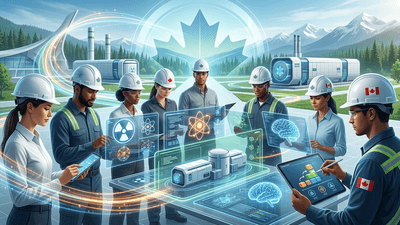



Canada's engineering sector is currently navigating a profound structural transition, caught between the macro demands of a multi-billion-dollar energy transition and the micro complexities of community-integrated design. As Western Canada pivots toward Small Modular Reactors (SMRs) to decarbonize its heavy industries, a critical bottleneck has emerged: a severe shortage of nuclear-literate engineering talent. However, a wave of new academic partnerships, artificial intelligence integrations, and community-focused initiatives are rapidly rewiring the profession to meet these 21st-century demands.
For engineering professionals and firm leaders, the message is clear: the future belongs to those who can seamlessly blend advanced technical upskilling with AI fluency and grassroots community engagement. From the control rooms of next-generation reactors to land-based learning initiatives in Indigenous communities, the scope of Canadian engineering is expanding.
The Western Nuclear Pivot: Accelerating Mid-Career Talent
Historically, Canada's nuclear engineering expertise has been heavily concentrated in Ontario and New Brunswick. But with Saskatchewan and Alberta aggressively pursuing SMRs to power their grids and resource sectors, the geographic center of gravity is shifting. The challenge? You cannot simply conjure a highly specialized nuclear workforce out of thin air.
To bridge this gap, Saskatchewan Polytechnic and Ontario Tech University have announced a strategic partnership to deliver the Nuclear Career Accelerator program in Western Canada. This initiative is a masterclass in agile workforce development, specifically targeting mid-career engineers and technologists who already possess foundational skills but lack specialized nuclear training.
Why the Accelerator Model Works
Rather than relying solely on four-year undergraduate pipelines to meet immediate industry needs, the online upskilling program allows mechanical, electrical, and civil engineers to pivot their careers without leaving the workforce. This model provides several strategic advantages for Western Canada's energy sector:
- Speed to Market: Upskilling existing professionals takes months rather than years, aligning talent availability with aggressive SMR deployment timelines.
- Cross-Disciplinary Expertise: Mid-career engineers bring valuable experience from oil and gas, mining, and traditional power generation, fostering cross-pollination of best practices in safety and project management.
- Geographic Retention: By offering the program online through a Western institution (Sask Polytech), the initiative helps retain local talent rather than forcing professionals to relocate eastward for specialized training.
| Workforce Strategy | Traditional Degree Pathway | Nuclear Career Accelerator |
|---|---|---|
| Target Demographic | Recent high school graduates | Mid-career engineers & technologists |
| Time to Completion | 4 to 5 years | Accelerated (Months to 1 year) |
| Industry Impact | Long-term pipeline stability | Immediate bottleneck relief for SMRs |
| Delivery Format | Primarily on-campus | Online, flexible, asynchronous |
AI as a Co-Pilot: Augmenting the Nuclear Knowledge Worker
As the workforce scales up to build these next-generation reactors, the technology used to operate them is also undergoing a radical transformation. SMRs are designed to be more autonomous and flexible than traditional large-scale nuclear plants, necessitating advanced operational software.
At the forefront of this shift is Dalhousie University's Faculty of Engineering, which is leading a critical project to develop next-generation AI tools for SMRs. Crucially, the research is not focused on replacing human operators. Instead, it aims to create human-centric, highly secure AI systems that support nuclear professionals in complex decision-making.
"The integration of AI in nuclear energy isn't about removing the human from the loop; it's about providing the human with unparalleled situational awareness. In a high-stakes environment like an SMR control room, AI acts as an ultimate fail-safe and analytical co-pilot."
The Market Verdict: Engineering Stocks as "AI Winners"
This reality—that AI will augment rather than replace highly regulated engineering work—is catching the attention of financial markets. According to recent analysis, Canadian engineering and infrastructure stocks are currently viewed as strong buying opportunities.
While some sectors fear AI-driven obsolescence, analysts recognize that the physical world still requires stamped drawings, regulatory compliance, and human accountability. In the engineering sector, AI is a pure productivity multiplier. Firms that successfully integrate AI tools—like those being developed at Dalhousie for the nuclear sector—will see expanded margins, faster project delivery, and enhanced safety protocols, making them highly attractive to investors.
Grounded Engineering: Designing for Community and Reconciliation
While SMRs and AI represent the high-tech frontier of Canadian engineering, the profession's core mandate remains deeply rooted in community impact. The most successful engineering projects in Canada are those that seamlessly integrate technical excellence with cultural and social responsiveness.
A shining example of this grassroots impact is currently unfolding on Prince Edward Island. Engineering students at the University of Prince Edward Island (UPEI) have partnered with the Lennox Island First Nation to design custom equipment for an elementary school. The students engineered a bespoke sap boiler and specialized drying racks to facilitate traditional land-based learning for Indigenous youth.
Why Grassroots Projects Matter to the Macro Economy
It is tempting to view projects like the UPEI sap boiler as mere academic exercises, disconnected from the multi-billion-dollar energy infrastructure boom. However, this perspective misses a fundamental shift in the Canadian engineering landscape:
- Stakeholder Integration: The skills required to consult with the Lennox Island First Nation, understand their unique needs, and design culturally appropriate equipment are the exact same skills required to negotiate land-use agreements for a new SMR site or transmission line.
- ESG Compliance: Environmental, Social, and Governance (ESG) criteria now dictate capital flow. Engineering firms that demonstrate a genuine capacity for Indigenous inclusion and community-centric design hold a distinct competitive advantage in procurement.
- Holistic Talent Development: Graduates who have engaged in tangible, community-driven projects enter the workforce with a highly developed sense of empathy and practical problem-solving—traits that AI cannot replicate.
By removing barriers to traditional learning, the UPEI students are not just building equipment; they are building trust. For the broader engineering sector, this serves as a potent reminder that infrastructure is ultimately about serving people.
The Path Forward: The Hybrid Engineer of 2026
As we look toward the remainder of the decade, the Canadian engineering profession is being asked to perform a complex balancing act. The transition to a net-zero economy demands a rapid escalation in specialized skills, evidenced by the Sask Polytech and Ontario Tech nuclear accelerator. Simultaneously, the explosion of artificial intelligence requires engineers to adapt to new, human-centric digital tools that enhance safety and productivity.
Yet, amidst this technological acceleration, the foundational requirement of engineering remains unchanged: building a safer, more equitable physical world. Whether it is deploying a Small Modular Reactor in rural Saskatchewan, integrating predictive AI into a control room, or designing a sap boiler for an Indigenous school on Lennox Island, the modern Canadian engineer must be as fluent in human connection as they are in thermodynamics and algorithms. Firms that recognize and cultivate this hybrid skill set will not only dominate the market—they will define the future of the profession.