
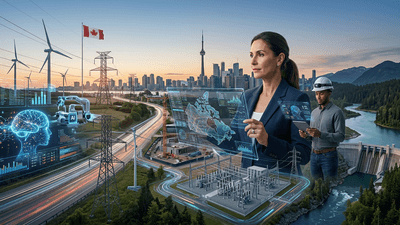



When the Association of Consulting Engineering Companies – Ontario (ACEC-Ontario) recently gathered to celebrate the province's top infrastructure and design achievements at the 2026 Ontario Engineering Project Awards, the mood was justifiably triumphant. From complex transit expansions to innovative water treatment facilities, the gala served as a masterclass in what Canadian engineers can accomplish. Yet, behind the clinking glasses and crystal trophies lies a pressing reality: the very nature of how these award-winning projects are designed, staffed, and powered is undergoing a radical, irreversible transformation.
As we navigate the back half of 2026, the Canadian engineering sector is caught between a proud legacy of traditional physical infrastructure and a rapidly accelerating digital frontier. To maintain the standard of excellence celebrated by ACEC-Ontario, firms must now solve a complex equation: integrating artificial intelligence to combat severe labour shortages, expanding the definition of engineering to include conversational agents, and retrofitting a national energy grid struggling under the weight of this new digital demand.
The Legacy of Leadership and the Talent Pipeline
Before we look at the algorithms reshaping our drafting tables, we must acknowledge the human element. The engineering marvels celebrated in Ontario this year were not born from software, but from visionary leadership and deep industry expertise—qualities that are becoming increasingly scarce as a generation of senior engineers retires.
Recognizing this critical gap, the industry is seeing a renewed focus on cultivating the next generation of leaders. A poignant example is the recent establishment of the Murray H. Pollitt Engineering Leadership Scholarship at the University of Toronto. Founded by alumnus Donovan Pollitt in memory of his father—a mechanical engineer and lifelong champion of Canadian industry—the scholarship underscores a vital truth: technical proficiency is no longer enough. Tomorrow's engineers must possess the leadership acumen to guide multidisciplinary teams through unprecedented technological shifts.
"The legacy of engineers like Murray Pollitt reminds us that at its core, engineering is about building robust, resilient Canadian industries. As the tools change, the mandate to lead with integrity and foresight remains our true north."
AI: The Antidote to the Labour Shortage
While scholarships build the long-term pipeline, engineering firms are facing an acute, immediate crisis: there simply are not enough hands to do the work required to meet Canada's infrastructure and housing goals. Enter Artificial Intelligence.
Rather than viewing AI as a threat to job security, industry leaders are embracing it as a critical survival mechanism. Alexandre L'Heureux, CEO of Montreal-based WSP Global, recently stated that AI is a "great thing" for the engineering sector amid the current industry-wide labour shortage. For mega-firms like WSP, AI is not about replacing engineers; it is about augmenting them.
Redefining Productivity
By automating repetitive tasks—such as initial site analysis, code compliance checks, and preliminary structural modeling—AI allows junior engineers to operate at the level of intermediate staff, and frees senior engineers to focus on complex problem-solving and client strategy. The practical implications for Canadian firms are profound:
- Accelerated Project Lifecycles: Feasibility studies that once took weeks can now be modeled in days using generative design algorithms.
- Error Reduction: AI-driven clash detection in BIM (Building Information Modeling) software drastically reduces costly on-site rework.
- Resource Allocation: Firms can bid on larger, more complex projects without needing to scale their headcount linearly.
The Expanding Definition of "Engineering"
As traditional consulting firms leverage AI for civil and mechanical projects, a new breed of engineering is taking root in Canada's tech hubs. The definition of the profession is expanding to include those who architect the very AI systems transforming the broader economy.
This shift is heavily evident in Quebec, where Clerk AI recently launched a new prompt engineering hub in Montréal. By expanding into Canada, Clerk AI is tapping into Montreal's rich ecosystem of highly skilled professionals to develop sophisticated conversational AI agents. This expansion signifies that "engineering" in 2026 is as much about structuring linguistic logic and training neural networks as it is about calculating load-bearing capacities.
For traditional engineers, the rise of prompt engineering hubs offers a unique opportunity for cross-pollination. The rigorous, systems-based thinking inherent in traditional engineering is exactly what is required to build safe, reliable, and hallucination-free AI models for industrial use.
The Physical Toll of Digital Growth: Powering the AI Boom
The irony of the AI revolution is that while it exists in the cloud, its physical footprint is staggering. Every prompt generated in Montreal, and every automated CAD rendering produced by WSP, requires massive amounts of computing power. This brings the digital revolution squarely back to the domain of traditional electrical, civil, and mechanical engineers.
Can Canada's energy systems meet this growing demand? According to experts at Ontario Tech University, powering the AI boom requires unprecedented cross-disciplinary integration. The energy required to cool and run hyper-scale data centres is putting immense strain on a grid already burdened by the electrification of transit and heating.
The Grid Modernization Mandate
Engineering professionals must now tackle a multi-front war to prepare Canada's energy systems for AI-driven demand:
- Microgrid Integration: Designing localized power generation (including Small Modular Reactors and renewables) specifically dedicated to data centre clusters.
- Advanced Thermal Management: Mechanical engineers must innovate beyond traditional HVAC, implementing liquid cooling and waste-heat recovery systems that can redirect data centre heat to local district heating networks.
- Predictive Load Balancing: Using the very AI that is causing the energy drain to predict peak usage times and dynamically route power across the provincial grid.
| Engineering Paradigm | Primary Challenge (2026) | The AI/Tech Solution |
|---|---|---|
| Civil & Structural | Chronic labour shortages and tight project delivery timelines. | Generative design, automated compliance checks, and predictive maintenance models. |
| Electrical & Energy | Grid capacity limits maxed out by data centres and electrification. | Smart grids, dynamic load balancing, and localized micro-generation. |
| Software & Systems | Need for reliable, industry-specific AI tools without hallucinations. | Prompt engineering hubs (e.g., Clerk AI) applying rigorous engineering standards to LLMs. |
Conclusion: Engineering a Convergent Future
The projects celebrated at the 2026 ACEC-Ontario gala are a testament to the resilience and ingenuity of Canadian engineers. But as we look toward 2030, the criteria for "excellence" will undoubtedly shift. The next generation of award-winning projects will not just be feats of concrete and steel; they will be testaments to digital integration, energy efficiency, and human-AI collaboration.
To thrive in this new era, Canadian engineering firms must honor the legacy of leaders like Murray Pollitt by investing in human talent, while aggressively adopting the AI tools championed by modern executives. Most importantly, the industry must break down the silos between software developers in Montreal, structural engineers in Toronto, and energy researchers at Ontario Tech. The future of Canadian engineering is not a choice between the physical and the digital—it is the seamless, masterful integration of both.