
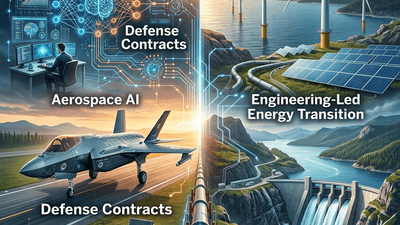



The mandate for Canadian engineering is no longer simply about building infrastructure; it is about securing the nation's strategic future. From the modernization of military bases to the integration of artificial intelligence in aerospace and the technological overhaul of our energy sector, the profession is entering a hyper-focused era of mission-critical execution. For engineering professionals across the country, this represents a fundamental shift in how projects are conceptualized, procured, and delivered.
Recent developments across three distinct sectors—defense, aerospace, and energy—highlight a unifying trend: the demand for advanced technological integration and engineering-led execution has never been higher. As traditional methodologies give way to AI, robotics, and precision engineering, the Canadian landscape is transforming into a global testing ground for next-generation industrial applications.
The Defense Infrastructure Mandate: AECOM and DCC
The most immediate indicator of this shift comes from the federal level, where the Department of National Defence (DND) is aggressively modernizing its physical and operational footprint. AECOM has recently been selected for the top-ranked position on Defence Construction Canada’s (DCC) National Architecture & Engineering Source List. This multi-year program, carrying a potential value of up to $270 million CAD, is a watershed moment for civil, structural, and systems engineering in Canada.
Defense infrastructure is uniquely demanding. It requires a convergence of high-security design, climate resilience, and advanced technological integration. The scope of the DCC mandate means that AECOM, alongside its strategic partners and subcontractors, will be tasked with delivering infrastructure that can withstand both modern geopolitical threats and extreme environmental conditions.
"This is not standard municipal civil engineering. Defense infrastructure requires a zero-fail operational environment. Every facility must be designed with redundant power systems, hardened communications networks, and a physical envelope capable of surviving extreme stress," notes a defense infrastructure specialist familiar with the DCC procurement process.
Implications for Civil and Structural Engineers
For Canadian engineering firms and independent professionals, the AECOM mandate signals a massive downstream opportunity. Projects of this scale rely heavily on local expertise across various provinces and territories. Engineers looking to capitalize on this wave of defense spending should focus on:
- Secure Facility Design: Understanding physical security protocols, blast-resistant structural engineering, and secure compartmentalized information facility (SCIF) standards.
- Climate-Resilient Infrastructure: Designing for extreme weather events, particularly for northern and Arctic defense installations where permafrost degradation is a critical concern.
- Energy Independence: Integrating microgrids and renewable energy sources into military bases to ensure operational continuity independent of the civilian grid.
Aerospace Innovation Takes Flight: The Mirabel Tech Hub
While defense infrastructure anchors the civil engineering sector, the aerospace industry in Quebec is pushing the boundaries of mechanical, materials, and software engineering. Airbus has officially established a new Tech Hub in Mirabel, Canada, signaling a major investment in the future of flight.
The Mirabel Tech Hub is not merely a manufacturing extension; it is an advanced research and development center designed to solve some of the most complex challenges in modern aviation. The facility will focus heavily on three core pillars: aerospace technology research, the development of sustainable materials, and the integration of artificial intelligence and industrial robotics into the manufacturing process.
The Convergence of AI and Manufacturing
The aerospace sector has long been a driver of engineering innovation, but the Airbus Tech Hub represents a shift from traditional aeronautical engineering toward a more interdisciplinary approach. The integration of industrial robotics and AI means that manufacturing processes are becoming highly automated, requiring engineers who can bridge the gap between hardware and software.
- Sustainable Aviation Materials: Materials engineers are being tasked with developing lighter, stronger composites that reduce fuel consumption while maintaining structural integrity.
- AI-Driven Quality Control: Software and systems engineers are implementing machine learning algorithms to inspect parts and predict maintenance needs before a component ever leaves the factory floor.
- Robotic Assembly: Mechanical and mechatronics engineers are designing the robotic systems that will assemble the next generation of commercial aircraft with micrometer precision.
For Canadian professionals, the Mirabel Tech Hub cements Quebec's status as a global aerospace powerhouse and creates a high-demand market for engineers with cross-disciplinary skill sets.
The Energy Sector's Engineering Pivot
Perhaps the most subtle, yet economically significant, shift is occurring in Canada's energy sector. Historically, the oil and gas industry was heavily reliant on geological exploration—finding the resource was the primary challenge. Today, the dynamic has fundamentally changed.
According to recent analysis on the evolving job market in the E&P sector, oil and gas production in Canada is increasingly becoming an engineering-focused industry. The transition is driven by the maturation of resource basins and the widespread adoption of horizontal drilling and advanced completion technologies.
From Exploration to Execution
The challenge is no longer locating the hydrocarbons; the geological mapping of Canada's major basins is largely complete. The modern challenge is extracting the resource as efficiently, safely, and cleanly as possible. This is an engineering problem, not a geological one.
This "factory model" of resource extraction relies heavily on petroleum, mechanical, and chemical engineers to optimize well trajectories, manage fluid dynamics, and minimize the environmental footprint of extraction operations. The focus has shifted from the uncertainty of exploration to the precision of engineering execution.
Mapping the Cross-Sector Evolution
To understand the breadth of this transformation, it is helpful to look at how traditional engineering roles are evolving across these three critical sectors. The demand for specialized, tech-integrated skills is rendering the "generalist" engineer obsolete in high-stakes projects.
| Sector | Traditional Focus | Emerging Engineering Focus (2026 & Beyond) |
|---|---|---|
| Defense (DCC/AECOM) | Standard structural design, basic operational facilities | Climate-resilient microgrids, blast-resistant structures, zero-fail secure networks |
| Aerospace (Airbus) | Aerodynamics, manual assembly processes, aluminum structures | AI-integrated robotics, sustainable composites, automated quality control |
| Energy (O&G) | Geological exploration, vertical drilling, seismic mapping | Horizontal drilling optimization, fluid dynamics, emission-reduction technologies |
This table illustrates a clear trajectory: Canadian engineering is moving up the value chain. The baseline requirements for major projects now include a deep understanding of data analytics, automation, and environmental sustainability.
Conclusion: Engineering the Future of Canada
The concurrent developments of AECOM’s $270 million defense mandate, Airbus’s Mirabel Tech Hub, and the engineering-led pivot in the energy sector are not isolated events. They are interconnected indicators of a profession in rapid evolution. Canadian engineers are no longer just builders; they are the architects of national security, pioneers of sustainable global transit, and the optimizers of the nation's economic engine.
For engineering firms, the message is clear: the future belongs to those who invest in cross-disciplinary innovation. Upskilling workforces in AI, robotics, and climate-resilient design is no longer a competitive advantage—it is a baseline requirement for participation in Canada's most lucrative and critical projects. As we look toward the remainder of the decade, the Canadian engineering sector stands ready to execute on a scale, and with a level of precision, the world has never seen.