
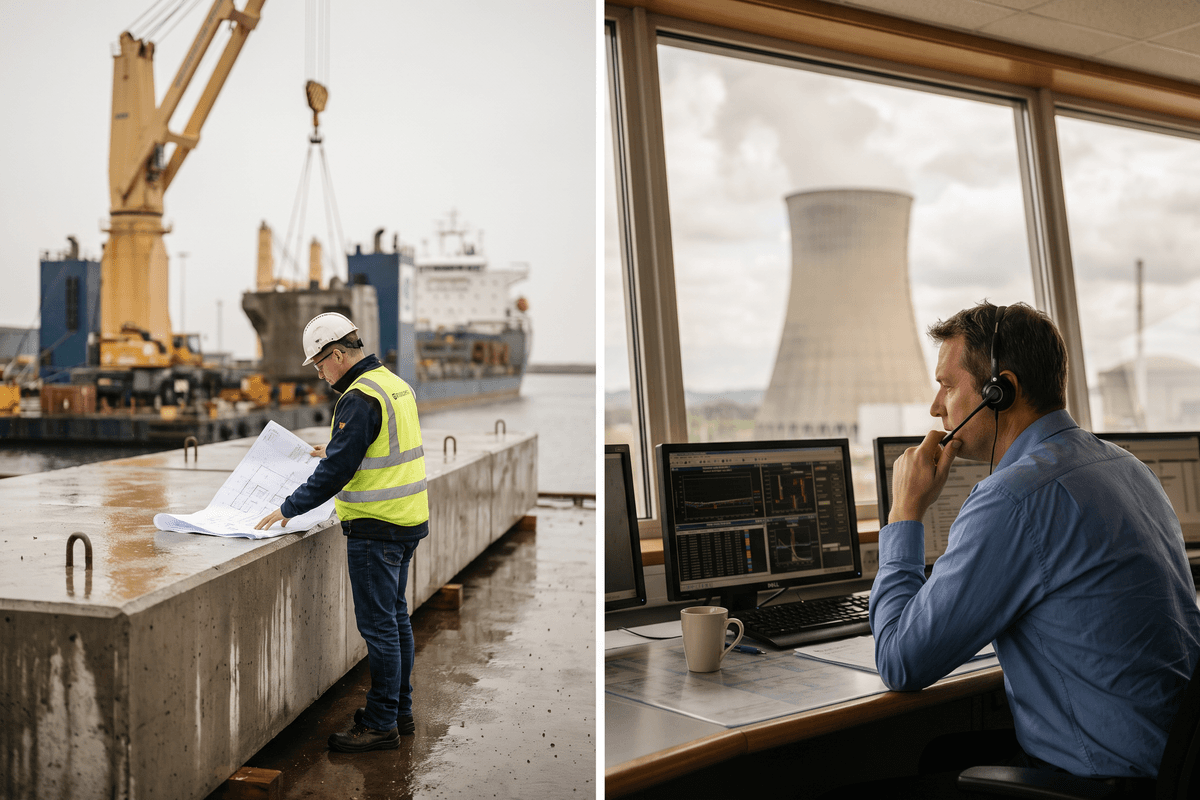



The definition of a Canadian "megaproject" is being aggressively rewritten. For decades, the engineering sector operated comfortably within the boundaries of incremental infrastructure expansion—adding lanes, upgrading municipal treatment facilities, and maintaining existing power grids. Today, driven by the dual pressures of extreme climate adaptation and a generational energy transition, the scale of capital projects has mutated. We are no longer just building infrastructure; we are re-engineering the subterranean geology of our largest cities and attempting to revive a highly specialized nuclear supply chain simultaneously.
This unprecedented convergence is forcing a reckoning within the Canadian engineering profession. As multi-billion-dollar civil works push current mechanical and geotechnical limits, a parallel crisis is emerging: the specialized talent required to design, model, and execute these behemoths is in critically short supply.
The Subterranean Leviathan: Pushing Civil Engineering to the Limit
To understand the sheer scale of the technical escalation, one only needs to look beneath the streets of the country's most populous city. According to a recent analysis by Water Canada, the nation's biggest water projects are pushing civil engineering to its absolute limits. The crown jewel of this infrastructure wave is Toronto's Don River and Central Waterfront Project.
Costing upwards of $3 billion, this is not a standard municipal plumbing upgrade. It is one of the most complex combined sewer overflow (CSO) management initiatives in North America. The project demands the excavation of a 22-kilometre tunnel network, plunging up to 50 metres deep into the Georgian Bay shale formation.
"These projects are no longer just about moving water; they are exercises in extreme geotechnical risk management, requiring millimeter-perfect execution in dense urban environments where the cost of failure is catastrophic."
The Technical Hurdles of Deep-Rock Excavation
The engineering demands of the Don River project highlight a broader trend in Canadian civil works: the shift toward deep, subterranean solutions to solve surface-level urban constraints. This requires navigating a labyrinth of technical challenges:
- Advanced Tunnel Boring Mechanics: Utilizing massive Tunnel Boring Machines (TBMs) that must simultaneously excavate rock, remove spoil, and install precast concrete lining rings under extreme hydrostatic pressure.
- Micro-Tunneling and Drop Shafts: Engineering vertical drop shafts that intercept existing surface infrastructure and channel torrential storm flows down into the main tunnel without causing destructive hydraulic surges or cavitation.
- Geotechnical Uncertainty: Navigating unpredictable fault lines, groundwater inflows, and varying rock densities while minimizing surface settlement in a hyper-dense metropolitan corridor.
For civil and structural engineering firms, projects of this magnitude require a pivot from traditional design-bid-build models to highly integrated, digitally twinned project delivery systems. The risk profiles are simply too large for siloed engineering disciplines.
The Talent Deficit in High-Stakes Sectors
While deep-water civil works strain our mechanical and geotechnical capabilities, another sector is exposing the fragility of our human capital. As Canada aggressively pursues a nuclear renaissance—including the deployment of Small Modular Reactors (SMRs) and the refurbishment of existing baseload facilities—the engineering talent pipeline is showing signs of severe stress.
The civil engineers designing deep-rock water tunnels and the nuclear engineers modeling reactor core physics share a common reality: their work requires a level of domain-specific specialization that takes a decade to cultivate. You cannot simply reassign a commercial HVAC engineer to design the cooling systems for an SMR, nor can a standard structural engineer sign off on the seismic tolerances of a nuclear containment vessel.
Forging the Next Generation of Specialists
The industry is beginning to recognize that relying on the open market for this level of talent is a failing strategy. Instead, we are seeing a shift toward deep, structural integration between mega-project proponents and academia.
A prime example of this proactive talent generation is the recent announcement that the University of Toronto has joined the Canadian Nuclear Laboratories' (CNL) Academic Partnership Program. Alongside Atomic Energy of Canada Limited (AECL), this alliance is specifically designed to nurture the next generation of nuclear science and engineering talent.
This is not a traditional, passive co-op arrangement. It is a targeted, strategic intervention designed to align academic curriculum directly with the immediate technical needs of the nuclear sector. The partnership focuses on:
- Collaborative Research: Funding joint research initiatives in advanced materials, radiobiology, and thermal hydraulics—the exact disciplines required to bring SMRs from concept to commercial reality.
- Facility Access: Granting engineering students and researchers access to the specialized, highly restricted infrastructure at the Chalk River Laboratories.
- Curriculum Alignment: Ensuring that graduates enter the workforce with the specific regulatory and safety-culture knowledge required by the Canadian Nuclear Safety Commission (CNSC), drastically reducing the onboarding time for engineering firms.
Comparative Complexities: Water vs. Nuclear
While civil water megaprojects and nuclear developments operate in different domains, comparing their engineering profiles reveals why the Canadian talent pool is currently stretched so thin. Both require massive capital deployment, both operate under intense public scrutiny, and both demand near-zero failure tolerances.
| Project Parameter | Deep-Water Civil Works (e.g., Don River) | Next-Gen Nuclear (e.g., SMR Deployment) |
|---|---|---|
| Core Engineering Challenge | Geotechnical risk management and extreme hydraulic flow control. | Thermal hydraulics, advanced materials degradation, and radiation shielding. |
| Regulatory Environment | Provincial environmental ministries, municipal conservation authorities. | Federal oversight via the Canadian Nuclear Safety Commission (CNSC). |
| Primary Talent Bottleneck | Senior geotechnical engineers, TBM specialists, and deep-shaft structural designers. | Nuclear physicists, regulatory compliance engineers, and advanced materials scientists. |
| Design Life Expectancy | 100+ Years | 60+ Years (with strict decommissioning protocols) |
The Practical Implications for Canadian Engineering Firms
For engineering executives, project managers, and senior technical leads operating in Canada, the convergence of these massive infrastructure demands dictates a fundamental shift in business strategy.
First, bidding on megaprojects now requires an academic strategy. Firms can no longer assume the talent will be there when the RFP is won. The CNL and U of T partnership is the blueprint. Engineering consultancies must embed themselves into university faculties, funding research chairs and co-developing curriculum, to secure a proprietary pipeline of specialized graduates.
Second, cross-disciplinary risk management is the new premium skill. The Don River project isn't just about civil engineering; it requires advanced fluid dynamics modeling, environmental remediation, and complex stakeholder management. Similarly, SMR deployment relies as much on civil site preparation and grid integration as it does on nuclear physics. Engineers who can translate risk across these silos will command the highest premiums in the market.
Finally, the era of the "generalist" firm in the megaproject space is ending. The technical limits being pushed by modern water infrastructure and nuclear energy require deep, highly capitalized specialization. We will likely see further consolidation in the market as mid-sized firms merge to acquire the necessary technical depth to compete for these multi-billion-dollar mandates.
Conclusion: Engineering at the Edge of Capacity
Canada is currently engineering at the absolute edge of its historical capacity. The sheer audacity of projects like the Don River deep-water tunnels and the strategic pivot back to nuclear baseload power represent a thrilling, albeit daunting, era for the profession.
The mechanical and geotechnical limits are being tested daily beneath our feet, while the intellectual limits are being expanded in our universities and national laboratories. The future of Canadian infrastructure will not be defined by the concrete we pour or the reactors we ignite, but by our ability to continuously forge the specialized engineering minds capable of taming these modern leviathans. For the firms willing to invest deeply in talent and embrace unprecedented technical risk, the next decade offers an opportunity to literally reshape the foundation of the country.