
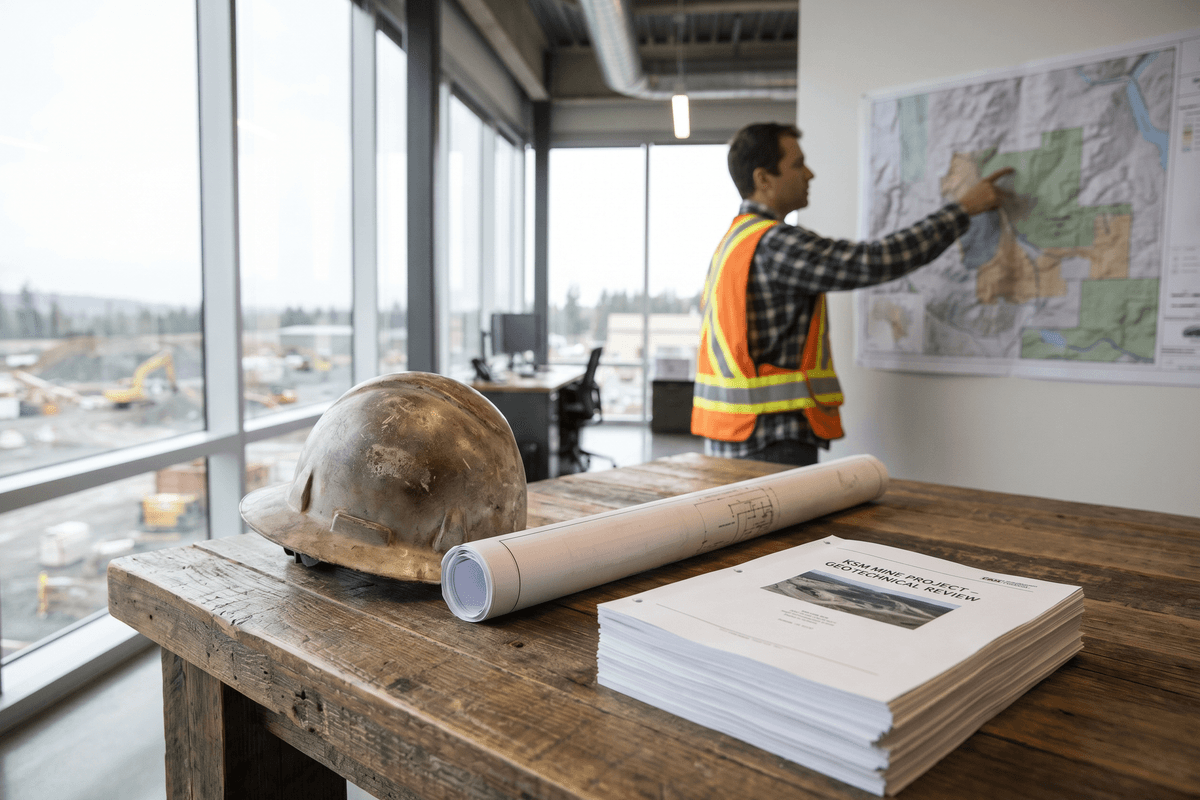



Deep in the rugged topography of British Columbia’s Golden Triangle lies one of the most resource-rich, yet logistically unforgiving, terrains on the planet. It is here that Seabridge Gold’s Kerr-Sulphurets-Mitchell (KSM) project—an $8.8 billion proposed copper and gold mine—has been navigating a labyrinth of engineering, financial, and regulatory challenges. Twelve years after receiving its initial environmental approvals, the project remains unbuilt, serving as a profound case study in the realities of modern Canadian megaproject execution.
For engineering professionals across the country, the KSM project is more than just a mining venture; it is a masterclass in the friction points that emerge when immense geological ambition meets stringent regulatory frameworks and capital volatility. As we look at the lifecycle of this massive undertaking, critical lessons emerge regarding tunneling logistics, capital expenditure (capex) preservation, and the strategic maneuvering required to maintain project viability over a decade-long gestation period.
The Paradox of Canadian Engineering Prowess
To understand the gravity of the KSM delays, one must first view it against the broader macroeconomic backdrop of the Canadian engineering sector. Currently, Canadian engineering and infrastructure services companies are experiencing a significant boom, benefiting immensely from global infrastructure investment trends. Driven by recurring project demand, energy transition mandates, and expanding opportunities across international markets, Canada’s tier-one firms are exporting their expertise at an unprecedented rate.
Yet, a paradox exists. While our engineering firms are highly sought after globally to deliver complex, multi-billion-dollar infrastructure, domestic megaprojects often find themselves mired in prolonged holding patterns. The KSM project exemplifies how domestic regulatory environments and extreme geographical constraints can bottleneck even the most well-capitalized and expertly engineered designs.
The KSM Megaproject: A 12-Year Holding Pattern
The KSM project is widely recognized as one of the largest undeveloped gold and copper resources in the world. However, extracting that resource requires an infrastructure footprint that rivals major civil transit projects. According to recent analyses of the KSM mine delays, the project's timeline has been severely stretched by the intersection of environmental permitting requirements, geotechnical complexities, and the sheer scale of the required upfront capital.
To grasp the scale of the challenge, consider the following breakdown of the project's core hurdles:
| Project Element | Engineering & Logistical Scope | Current Reality & Challenge |
|---|---|---|
| Capital Expenditure | Estimated at $8.8 billion CAD for initial construction and infrastructure development. | Inflationary pressures over a 12-year delay have forced continuous re-evaluation of project economics and joint-venture strategies. |
| Geotechnical (Tunneling) | Twin 23-kilometer Mitchell Treaty Tunnels (MTT) for ore transport and personnel access. | Requires navigating complex alpine fault zones, high rock stresses, and remote Tunnel Boring Machine (TBM) logistics. |
| Regulatory Permitting | Securing and maintaining Environmental Assessment (EA) certificates. | Required massive early-works spending just to achieve a "Substantially Started" designation to prevent certificate expiry. |
Core Geomechanical and Logistical Hurdles
At the heart of the KSM project's engineering challenge is the spatial separation between the mine site and the processing facilities, necessitated by the steep, avalanche-prone terrain of the Golden Triangle.
The Tunneling Challenge
To connect the extraction site to the processing plant and tailings management facility, engineers designed the Mitchell Treaty Tunnels (MTT)—twin 23-kilometer tunnels driven through the Coast Mountains. For geotechnical and civil engineers, this represents a monumental undertaking. Tunneling through this specific geological setting involves mitigating risks associated with:
- High In-Situ Stresses: The depth of cover in mountainous terrain can lead to significant rockburst risks and squeezing ground conditions, demanding robust and adaptable ground support systems.
- Hydrogeological Complexity: Intersecting major aquifers or fault zones can result in high-pressure water ingress, requiring advanced pre-excavation grouting and specialized TBM design (such as Earth Pressure Balance or Slurry machines tailored for hard rock and high water pressure).
- Logistical Isolation: Transporting TBM components, managing tunnel muck, and supplying continuous power in a region with limited existing infrastructure adds layers of complexity to the construction schedule.
Capital Expenditure and Inflationary Pressures
Time is the enemy of capital. When a project carries an $8.8 billion price tag, a 12-year delay exposes the underlying financial models to multiple cycles of inflation. For cost engineers and project managers, the KSM scenario highlights the vulnerability of initial Front-End Engineering Design (FEED) estimates.
Over the past decade, the cost of structural steel, specialized labor, and heavy machinery has skyrocketed. Furthermore, the cost of capital itself has increased with rising interest rates. Engineers must now design not just for structural integrity, but for capital agility—phasing construction in a way that allows for earlier revenue generation or modular expansion to offset initial capex shock.
Navigating the "Substantially Started" Threshold
Perhaps the most critical lesson from the KSM project lies in the intersection of engineering execution and environmental law. In British Columbia, an Environmental Assessment (EA) certificate is not granted in perpetuity. Projects are given a strict window to commence construction; if they fail to do so, the certificate expires, sending the project back to square one.
To avoid this, Seabridge Gold had to prove to regulators that the KSM project was "substantially started." This legal threshold forced a unique engineering strategy: prioritizing and executing massive early-works programs—such as building permanent camps, bridges, access roads, and power infrastructure—long before the primary mining and tunneling operations could commence.
"The regulatory ticking clock fundamentally alters the critical path of a megaproject. Engineering teams are no longer just optimizing for the most efficient construction sequence; they are optimizing for regulatory survival, deploying hundreds of millions in capital early just to keep the project's legal heartbeat alive."
This reality requires Canadian engineers to integrate legal and regulatory milestones directly into their Work Breakdown Structures (WBS) and risk management matrices, treating a permit expiry date with the same gravity as a critical structural load limit.
Strategic Lessons for Engineering Leaders
The ongoing saga of the KSM mine provides actionable intelligence for engineering firms bidding on, designing, or managing Canadian megaprojects. The primary takeaways include:
- Integrate Regulatory Milestones into the Critical Path: Early-works engineering must be designed not just for site preparation, but to satisfy specific legal definitions of project commencement.
- Modularize Capex Where Possible: Megaprojects must move away from "all-or-nothing" financial models. Engineering designs that allow for phased commissioning can help insulate projects from long-term inflationary cycles.
- Prioritize Geotechnical Derisking: In projects involving extensive tunneling or earthworks, early and aggressive geotechnical investigation is the most cost-effective insurance policy against mid-construction scope creep.
- Leverage Global Expertise Locally: As Canadian firms succeed internationally, bringing those optimized, global best practices in project delivery back to domestic projects can help streamline execution.
Conclusion: Engineering for Reality, Not Just the Blueprint
The KSM mine remains a testament to both human ambition and the formidable realities of the Canadian landscape. As Canadian engineering firms continue to thrive on the global stage, bridging the gap between international success and domestic megaproject execution will require a paradigm shift.
The 12-year delay of an $8.8 billion project is a stark reminder that a perfect blueprint is only the beginning. The engineers who will lead Canada into its next era of infrastructure and resource development will be those who can seamlessly weave geotechnical mastery, financial pragmatism, and regulatory foresight into a single, resilient project lifecycle. In the Golden Triangle, and across the nation, engineering excellence must now be defined not just by what we can design, but by what we can successfully navigate through to completion.