
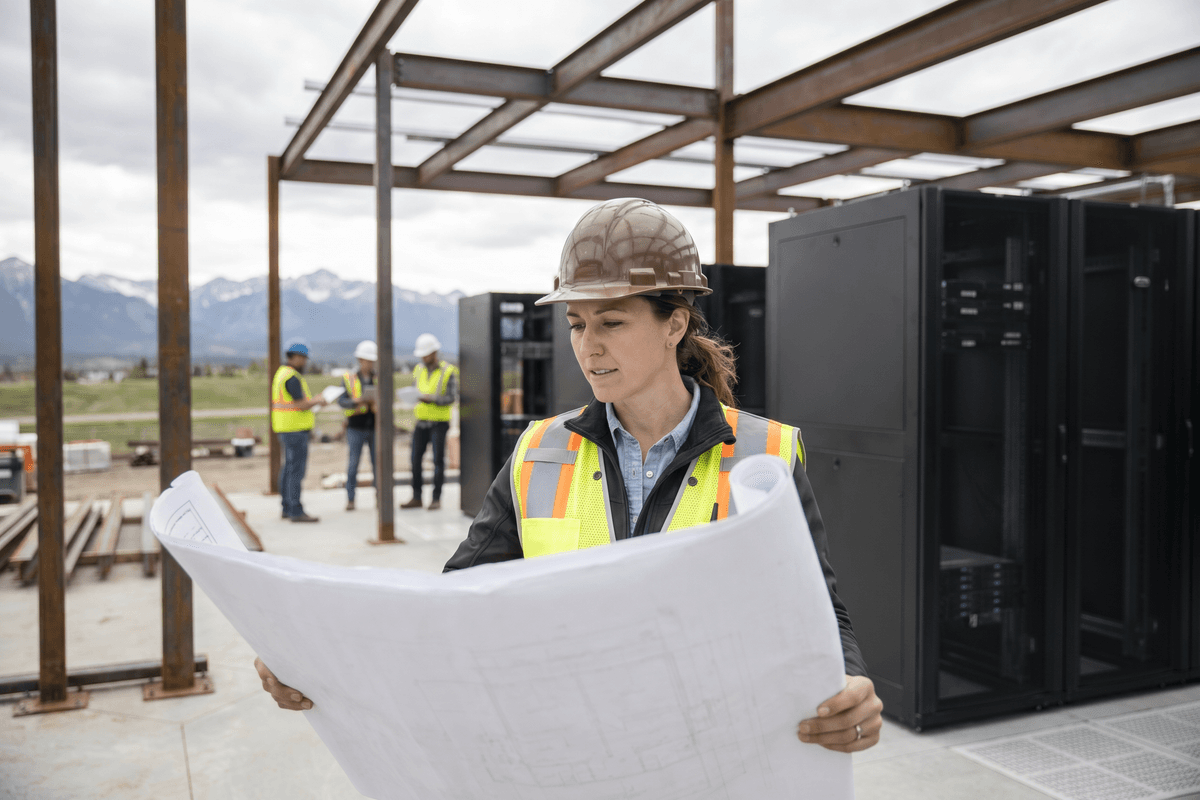



When a technology giant announces a capital expenditure that rivals the GDP of a small island nation, it ceases to be just a tech story. It becomes a generational engineering challenge. Meta's recent announcement of a $13-billion AI data centre in Sturgeon County, Alberta, represents the largest single technology infrastructure investment in Canadian history. For Canadian engineering professionals, this is not merely a headline—it is a massive pivot point that will stress-test and redefine our capabilities in power distribution, thermal management, and mega-project execution.
The facility, which promises to create 3,000 construction jobs and fundamentally alter the local infrastructure landscape, is a clear signal: the artificial intelligence boom has left the theoretical realm of software and entered the physical, resource-heavy domain of heavy civil and industrial engineering. For EPC (Engineering, Procurement, and Construction) firms, mechanical engineers, and electrical consultants, the Sturgeon County project offers a high-stakes blueprint for the future of industrial design.
The Power Equation: Rewiring for High-Density AI
To understand the engineering gravity of this project, one must understand the difference between a traditional cloud data centre and an AI-specific data centre. Traditional server racks draw anywhere from 5 to 15 kilowatts (kW) of power. Racks packed with the latest AI GPUs—the engines driving large language models—can draw upwards of 100 to 120 kW per rack.
This exponential leap in power density is precisely why Alberta was chosen. The province's deregulated electricity market and robust natural gas baseline provide the rapid scalability that hyperscalers demand. However, delivering that power from the grid to the chip is an electrical engineering gauntlet.
Electrical Engineering Imperatives
- Substation Design and Grid Interconnection: A facility of this scale will likely require multiple dedicated high-voltage substations. Engineers will need to design robust transmission interconnects capable of handling hundreds of megawatts without destabilizing the regional grid.
- Uninterruptible Power Supply (UPS) at Scale: Designing battery backup and generator systems for a facility drawing gigawatt-level power requires massive, modular UPS topologies. The shift is moving from traditional lead-acid to lithium-ion, requiring stringent fire suppression and structural engineering integration.
- Harmonic Mitigation: The massive array of power supplies converting AC to DC for server racks introduces significant harmonic distortion into the electrical system, requiring advanced active filtering design to protect upstream transformers.
"The AI infrastructure race is no longer just about silicon; it is fundamentally a thermodynamics and power distribution challenge. If you cannot cool it or power it reliably, the software simply does not run."
The End of Air Cooling: A Mechanical Engineering Renaissance
For decades, data centre mechanical engineering relied on a relatively standardized playbook: massive Computer Room Air Conditioning (CRAC) units, hot aisle/cold aisle containment, and raised floors. Meta's $13-billion facility effectively renders that playbook obsolete.
You cannot air-cool a 100kW AI rack efficiently. The thermodynamic reality of next-generation GPUs necessitates a complete shift to liquid cooling. For Canadian mechanical engineers, this project will accelerate the domestic adoption of advanced thermal management systems.
Key Mechanical Shifts
- Direct-to-Chip Liquid Cooling: Pumping engineered dielectric fluids or treated water directly to cold plates mounted on the GPUs. This requires precision plumbing, leak-detection systems, and complex fluid dynamics modeling to ensure even flow across thousands of nodes.
- Immersion Cooling Potential: While direct-to-chip is current state-of-the-art, facilities of this scale are increasingly future-proofing for two-phase immersion cooling, where entire server chassis are submerged in boiling dielectric fluid.
- Heat Rejection and Waste Heat Utilization: Moving the heat out of the building requires massive cooling towers or dry coolers. Given Sturgeon County's cold climate, engineers will leverage "free cooling" (economizers) for most of the year. Furthermore, the sheer volume of low-grade waste heat presents an opportunity for district heating integration or agricultural (greenhouse) applications in the surrounding region.
Civil and Geotechnical Realities in the Industrial Heartland
Locating this mega-project in Sturgeon County—part of Alberta's Industrial Heartland—is a strategic masterstroke, but it comes with distinct heavy civil engineering requirements. The region is traditionally zoned for petrochemical and heavy industrial processing. Adapting this environment for a hyper-clean, ultra-sensitive digital facility bridges two very different engineering disciplines.
Geotechnical engineers will face the challenge of designing foundations capable of supporting incredibly dense floor loads. The weight of liquid cooling manifolds, high-density server racks, and massive structural steel spans to eliminate interior columns requires deep pile foundations and rigorous soil stabilization, particularly considering Alberta's freeze-thaw cycles.
Furthermore, the logistics of mobilizing 3,000 construction workers necessitate temporary infrastructure akin to a small city. Traffic modeling, water/wastewater management for the construction camp, and environmental permitting will demand tier-1 project management capabilities.
The Talent Squeeze and EPC Execution
Perhaps the most immediate impact on the Canadian engineering sector will be the talent vacuum. A $13-billion project will absorb a massive percentage of available structural, mechanical, electrical, and project management talent in Western Canada. This comes at a time when the region is already balancing major energy transition projects, pipeline completions, and municipal infrastructure upgrades.
To meet Meta's aggressive deployment timelines, Canadian EPCs will have to heavily rely on Design for Manufacture and Assembly (DfMA). We will see an unprecedented use of prefabricated electrical skids, modular cooling plants, and pre-cast concrete structures assembled off-site and integrated seamlessly in Sturgeon County.
Comparing Data Centre Eras
The leap in engineering complexity becomes clear when comparing traditional cloud facilities to the new AI-driven standard:
| Engineering Metric | Traditional Cloud Data Centre | Next-Gen AI Mega-Centre (Meta) |
|---|---|---|
| Rack Power Density | 5 kW - 15 kW | 50 kW - 120+ kW |
| Primary Cooling Method | Air (CRAC, Hot/Cold Aisle) | Direct-to-Chip Liquid / Immersion |
| Structural Floor Load | Standard Commercial / Light Industrial | Heavy Industrial (due to liquid & battery density) |
| Grid Dependency | Standard Substation (10-50 MW) | Gigawatt-scale / Dedicated High-Voltage Feeds |
Conclusion: Blueprinting Canada's Digital Industrial Future
Meta's $13-billion investment in Alberta is more than a commercial real estate transaction; it is a catalyst for the Canadian engineering sector. It forces domestic firms to rapidly upskill in ultra-high-density power distribution, fluid dynamics, and modular mega-project execution.
If the Canadian engineering community can successfully deliver this facility on time and to the exacting standards of the world's most demanding tech giants, it will prove that Canada's industrial heartland is capable of exporting more than just energy and natural resources. We will establish ourselves as the premier global destination for the physical infrastructure that powers the artificial intelligence revolution. For engineers across the country, the message is clear: the future is dense, it is liquid-cooled, and it is being built right here.