
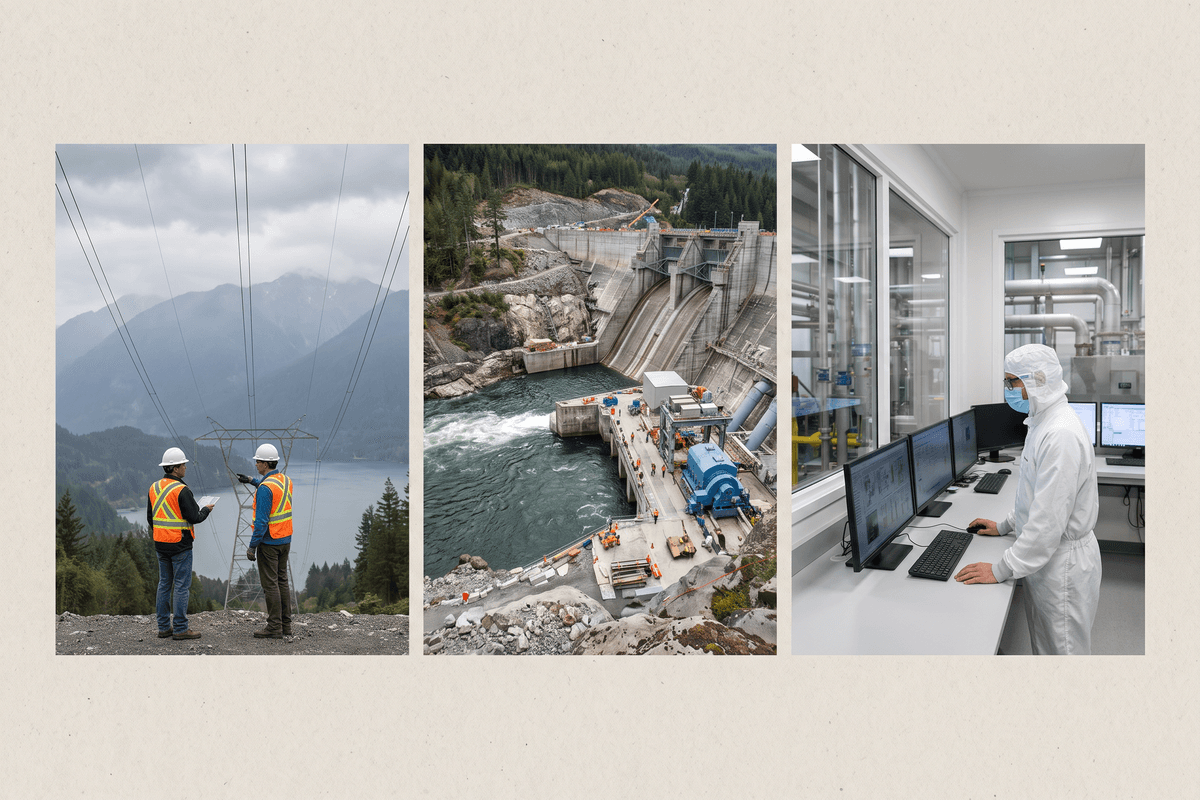



From the jagged mountain passes of British Columbia to the granite bedrock of Labrador and the high-precision manufacturing corridors of southern Ontario, Canada’s heavy power engineering sector is mobilizing for an unprecedented infrastructure supercycle. As electrification targets collide with massive industrial demand—ranging from critical minerals extraction to port decarbonization and baseload clean power—the nation's grid infrastructure is undergoing a multi-gigawatt overhaul that will define consulting engineering, procurement, and construction (EPC) disciplines for the next three decades.
The pace of this structural shift accelerated significantly this week as federal and provincial authorities officially broke ground on Phase 1 of the North Coast Transmission Line in northern British Columbia. When paired with advancing multi-firm engineering studies for a 14-GW hydropower and transmission expansion in Labrador and Ontario's strategic push to secure nuclear engineering and manufacturing supply chains, a cohesive national picture emerges: Canadian engineering firms are transitioning from regional project execution to delivering complex, interdependent, continent-scale energy corridors.
The Western Corridor: Engineering the North Coast Transmission Line
The groundbreaking on Phase 1 of British Columbia’s North Coast Transmission Line represents more than a regional utility upgrade; it is a foundational high-voltage lifeline engineered to decarbonize one of Canada’s most energy-intensive export gateways. Traversing extreme coastal topography, dense temperate rainforests, and avalanche-prone corridors, the project requires sophisticated civil, geotechnical, and electrical systems integration.
"Expanding high-voltage transmission into remote coastal corridors is fundamentally a challenge of terrain mechanics, climatic resilience, and multi-system load balancing under extreme weather envelopes."
For transmission line engineers, the North Coast corridor demands innovative foundation design to address complex geotechnical stratigraphy, including marine clays, fractured metamorphic rock, and high seismic risk zones along the Pacific Rim. Tower placement must withstand heavy wet snow loading, microburst wind shear, and severe rime ice accretion. Furthermore, the substation engineering involves advanced Static Synchronous Compensators (STATCOMs) and flexible AC transmission systems (FACTS) to maintain voltage stability across long radial feeds serving high-demand industrial nodes like the Port of Prince Rupert and nascent green hydrogen facilities.
The Eastern Giant: Multi-Firm Studies for Labrador’s 14 GW Frontier
While British Columbia breaks ground on transmission, eastern Canada is laying the analytical and geotechnical groundwork for what could become the largest coordinated clean power development in North America. Consulting engineering giants including Stantec and WSP Global are actively executing comprehensive environmental and geotechnical engineering studies for the monumental expansion of Churchill Falls and the untapped Gull Island hydro project.
With an estimated potential capacity reaching 14 GW across hydro, wind, and transmission systems, the engineering scope spans several critical technical disciplines:
- Subsurface Rock Mechanics: Detailed core logging, seismic profiling, and hydraulic fracturing stress measurements to design massive underground powerhouses and tailrace tunnels within Canadian Shield granite.
- HVDC Super-Grid Integration: Engineering long-distance High-Voltage Direct Current (HVDC) bipole transmission lines capable of wheeling multi-gigawatt baseload across subsea straits (such as the Strait of Belle Isle) and tundra terrain to eastern load centres.
- Hydraulic and Reservoir Modeling: Advanced computational fluid dynamics (CFD) to optimize spillway capacities, sedimentation transport, and ice-dam mitigation under evolving climate variability models.
These studies, highlighted in recent engineering project filings, demonstrate how geotechnical risk characterization is becoming the primary gating item for multi-billion-dollar clean energy capital deployment.
The Generation Anchor: De-Risking the Nuclear Supply Chain in Ontario
Transmission corridors and remote hydro assets cannot solve the clean grid equation in isolation; baseload reliability remains the operational linchpin. In Ontario, the province’s $1.9 million investment to audit and expand the nuclear supply chain highlights a critical vulnerability in the Canadian engineering ecosystem: capacity constraints in nuclear-grade engineering, specialized manufacturing, and skilled technical labor.
As life-extension projects at Bruce and Darlington progress alongside engineering design work for the first fleet of GE Hitachi BWRX-300 Small Modular Reactors (SMRs) at Darlington, engineering consultancies and precision fabricators face intense qualification hurdles:
- Nuclear Quality Assurance (NQA-1 & CSA N286): Upgrading Tier 2 and Tier 3 domestic suppliers to meet stringent nuclear regulatory standards.
- Digital Twin & System Verification: Implementing advanced digital engineering pipelines to validate reactor core physics, containment structures, and automated safety actuation systems.
- Workforce Pipeline Scalability: Bridging the structural shortage of specialized materials engineers, nuclear safety analysts, and welding inspectors needed to support parallel mega-builds.
Comparing Canada’s Major Power Engineering Megaprojects
The scale of engineering talent and capital equipment required across these initiatives requires a strategic view of domestic project delivery capabilities:
| Project / Region | Primary Engineering Domain | Key Technical Challenges | Critical Milestone Status |
|---|---|---|---|
| BC North Coast Transmission | High-Voltage HVAC / Geotechnical / Substation Design | Avalanche mitigation, marine clay foundations, dynamic grid stability | Phase 1 Groundbreaking / Construction Active |
| Labrador 14 GW Clean Power | Deep Hydro Civil / HVDC Transmission / Rock Mechanics | Underground caverns, subsea cable crossing, sub-arctic hydrology | Comprehensive Geotechnical & Environmental Engineering Studies |
| Ontario Nuclear Fleet & SMRs | Nuclear Mechanical / Materials Engineering / CSA N-Series QA | Precision pressure vessel fabrication, modular containment, workforce capacity | Supply Chain Audits & Pre-Construction Licensing |
Implications for Canadian Engineering Practice
The convergence of the North Coast groundbreaking, Atlantic mega-hydro studies, and Ontario's nuclear industrial policy marks the end of siloed utility planning. For consulting engineers, project managers, and EPC contractors, three operational imperatives have emerged:
1. The Integration of Terrestrial Geotechnics with Advanced Grid Control
Modern transmission lines are no longer passive steel-and-conductor corridors. The deployment of advanced dynamic line rating (DLR) sensors, fiber-optic structural health monitoring inside ground wires, and automated VAR compensators means that civil, structural, and electrical engineers must work in unified digital twin environments from day zero.
2. Collaborative Indigenous Co-Engineering Models
Both the North Coast line and the Labrador expansions demonstrate that technical design must be co-developed with First Nations and Indigenous communities. From right-of-way routing to environmental baseline monitoring, engineering workflows are incorporating Indigenous Traditional Knowledge alongside LiDAR and satellite interferometry, establishing a new standard for Canadian project approvals.
3. Cross-Disciplinary Talent Mobilization
The sheer scale of these projects will test domestic engineering human resources. Professionals with expertise in high-voltage substation engineering, rock cavern excavation, and nuclear-grade piping design are in unprecedented demand. Firms that invest in multi-disciplinary internal academies and digital automation in design delivery will dominate market share over the coming decade.
As ground crews mobilize heavy equipment along the Skeena corridor and drill rigs sample Labrador's granite core, Canada is executing one of the most technically ambitious energy infrastructure transformations in its history. The engineering decisions made in these project corridors today will anchor the country’s industrial competitiveness and carbon trajectory for the next half-century.