
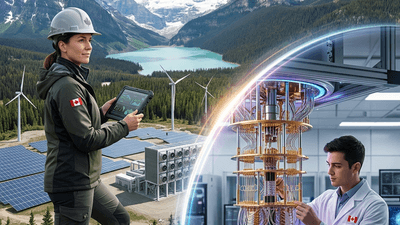



Canadian engineering operates on two vastly different, yet equally vital, frontiers. On one end of the spectrum, our professionals are delving into the subatomic realm, engineering hardware that operates at temperatures colder than deep space. On the other, they are mapping the macro-environment, deploying aerial robotics to fortify our cities against the immediate, escalating threats of climate change.
This duality is the defining characteristic of Canada's modern engineering ecosystem. We are simultaneously building the foundational architecture for the next century's computing revolution and desperately retrofitting the infrastructure of the last century to survive today's weather extremes. Recent breakthroughs from the University of Waterloo and McMaster University perfectly encapsulate this dynamic, highlighting a profession that is as comfortable commercializing quantum mechanics as it is reinforcing concrete levees.
The Subatomic Frontier: Commercializing Quantum Hardware
The transition of quantum computing from theoretical physics to applied engineering is accelerating, and Canadian talent is at the tip of the spear. This week, QuantumCore, a startup co-founded by a University of Waterloo engineering professor, announced a successful $10.7 million funding round. Their mission? To commercialize a highly specialized amplifier designed specifically for superconducting quantum chips.
To understand the engineering significance of this, we must look at the current bottleneck in quantum hardware. Superconducting qubits—the fundamental building blocks of many leading quantum architectures—operate at near absolute zero. The signals they produce are incredibly faint. Reading these signals without introducing thermal noise or destroying the quantum state is one of the most complex challenges in modern electrical and hardware engineering.
Solving the Readout Bottleneck
QuantumCore's technology addresses this exact vulnerability. By developing an amplifier that can boost these microscopic signals with unprecedented fidelity, they are solving a critical hardware scaling issue. For engineering professionals in the semiconductor, telecommunications, and electronics sectors, this development signals a broader industry shift.
- Microwave Engineering Renaissance: The demand for engineers skilled in high-frequency microwave electronics is surging, driven entirely by the needs of quantum control systems.
- Cryogenic Hardware Design: Traditional thermal management focuses on dissipating heat. Quantum engineering requires designing materials and circuits that function reliably in cryogenic dilution refrigerators.
- Academic-to-Industry Pipelines: The $10.7 million raise underscores the viability of the "academic entrepreneurship" model in Canada, where university labs serve as the ultimate incubators for deep-tech hardware.
"The commercialization of quantum amplifiers is not just a physics milestone; it is a profound engineering achievement. It proves that we can manufacture and scale the delicate hardware required to move from experimental quantum labs to commercially viable data centers."
For Canadian electrical and materials engineers, the message is clear: the quantum supply chain is maturing, and it requires traditional engineering rigor to scale.
The Macro Reality: Fortifying Climate-Resilient Infrastructure
While quantum engineers battle thermal noise in cryogenic chambers, civil and structural engineers are battling the very real, very loud forces of nature. As climate change accelerates, the frequency and severity of flooding in Canada have rendered traditional infrastructure risk models obsolete.
Addressing this requires a modernization of civil engineering practices. At McMaster University, civil engineering researchers are leading the charge by integrating advanced drone technology and Geographic Information Systems (GIS) to assess and improve Canada's critical flood defense structures.
Data-Driven Civil Engineering
Historically, flood defense assessments relied on static topographical maps, historical weather data, and manual visual inspections of levees, dams, and retaining walls. Today, that approach is dangerously inadequate. The McMaster initiative represents a paradigm shift toward dynamic, data-rich infrastructure management.
By deploying drones equipped with LiDAR and high-resolution photogrammetry payloads, engineers can generate millimeter-accurate 3D models of flood defenses and surrounding topographies. When fed into advanced GIS platforms, this data allows for:
- Predictive Vulnerability Mapping: Identifying micro-fissures, soil subsidence, or structural fatigue in levees before a catastrophic failure occurs.
- Dynamic Hydrological Modeling: Simulating how changing water flows and extreme weather events will interact with current defenses in real-time.
- Optimized Retrofitting: Directing municipal and federal infrastructure budgets precisely to the areas with the highest probability of failure, maximizing the ROI of public works spending.
For civil engineers, surveyors, and urban planners, the integration of aerial robotics and GIS is no longer a niche specialization—it is becoming the baseline standard of care for municipal infrastructure projects.
Comparing the Frontiers: Skills and Impact
Though they seem worlds apart, the hardware engineers at QuantumCore and the civil engineers at McMaster share a common trajectory: moving from analog, theoretical models to hyper-precise, data-driven applications. Below is a breakdown of how these two distinct fields are evolving in the Canadian market.
| Engineering Domain | Core Technologies Utilized | Primary Professional Challenge | Economic Impact for Canada |
|---|---|---|---|
| Quantum Hardware | Superconducting circuits, Cryogenics, Microwave electronics | Signal fidelity, Thermal noise reduction, Manufacturing scalability | Positioning Canada as an exporter of deep-tech components in a multi-billion dollar global quantum market. |
| Civil & Infrastructure | UAVs (Drones), LiDAR, GIS, Hydrological modeling software | Predictive maintenance, Climate adaptation, Budget optimization | Preventing billions in property damage and securing critical supply chains against climate disruptions. |
As we look to the remainder of the decade, the demands placed on the Canadian engineering sector will only intensify. We will be asked to compute faster and build stronger, to navigate the microscopic laws of quantum mechanics and the macroscopic fury of a changing climate.
The successes of startups like QuantumCore and the applied research at institutions like McMaster prove that our engineering pipeline is up to the task. By continuing to foster deep-tech commercialization while simultaneously modernizing our approach to civil infrastructure, Canada is not just adapting to the future—we are actively engineering it.