
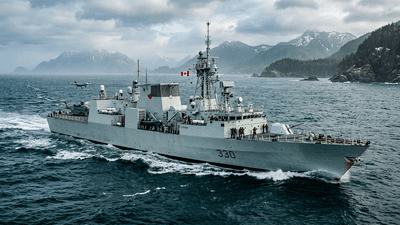



Geopolitical realities are rapidly melting the ice of complacency in Canada's defence and security sectors. As the federal government accelerates its recapitalization of military assets, the Canadian engineering industry finds itself at the fulcrum of a massive industrial pivot. We are no longer simply maintaining legacy infrastructure; we are being tasked with designing, integrating, and ruggedizing the next generation of sovereign capabilities. From the crushing depths of the Arctic Ocean to the tactical edge of the modern battlefield, the mandate for Canadian engineers has never been clearer: build it resilient, build it secure, and build it at home.
The Macro Shift: Submarines and Domestic Industrial Resilience
For decades, Canada's naval procurement has been a complex web of international purchases and delayed domestic integrations. However, a recent strategic alignment signals a maturation in how Canada plans to approach its maritime engineering capabilities. Canadian engineering and nuclear powerhouse AtkinsRéalis has signed a landmark Memorandum of Understanding (MoU) with South Korean shipbuilding giant Hanwha Ocean. Their shared objective? To chart a new course for Canada's submarine future.
This partnership is not merely a bid for the upcoming Canadian Patrol Submarine Project (CPSP); it is a blueprint for what the industry calls domestic industrial resilience. By pairing Hanwha's world-class maritime manufacturing with AtkinsRéalis's deep expertise in nuclear engineering, lifecycle management, and complex systems integration, the MoU ensures that the intellectual property and engineering execution remain firmly rooted in Canada.
Engineering the Deep
For Canadian mechanical, structural, and systems engineers, the implications of this MoU are profound. Modern submarines are arguably the most complex engineering feats on the planet—closed-loop ecosystems that must operate flawlessly in extreme pressure environments while remaining acoustically invisible. The integration of these vessels will require specialized engineering services, including:
- Advanced Acoustic Engineering: Designing vibration isolation mounts and sound-damping metamaterials to minimize the vessel's acoustic signature.
- Nuclear and Alternative Propulsion Integration: Leveraging AtkinsRéalis's Candu heritage to navigate strict regulatory and safety frameworks for high-density power systems.
- Lifecycle Digital Twin Development: Creating high-fidelity digital models for predictive maintenance, a necessity for vessels operating in remote Arctic waters where physical support is non-existent.
"The AtkinsRéalis and Hanwha Ocean partnership represents a critical tech-transfer mechanism. It guarantees that the high-value engineering work—the systems integration, the thermal dynamics, the software architecture—happens on Canadian soil, upskilling our domestic workforce for a generation."
The Micro Shift: Ruggedizing the Tactical Edge
While multi-billion-dollar naval platforms dominate the headlines, a quieter but equally critical revolution is happening at the micro-level of Canadian defencetech. As military operations become increasingly data-driven, the demand for secure, high-performance computing in extreme environments has skyrocketed.
Enter the Canadian Defencetech Initiative. Recently, Convergence X selected Ottawa Infotainment to develop a defence-focused variant of its DragonFire Pro platform. The goal is to build a next-generation ruggedized compute platform tailored for secure, mission-critical environments.
It might seem counterintuitive for a company with "Infotainment" in its name to be tasked with tactical military hardware. However, modern military vehicles and command centers require the same high-bandwidth data processing, low-latency sensor fusion, and intuitive user interfaces found in advanced autonomous vehicles. The engineering challenge lies in ruggedization—taking commercial-off-the-shelf (COTS) performance and hardening it against the brutal realities of the battlefield.
The SWaP-C Challenge
For electrical and computer engineers, the DragonFire Pro contract highlights the ongoing battle with SWaP-C (Size, Weight, Power, and Cost). Engineering a ruggedized platform requires mastering several distinct disciplines:
- Thermal Management: Dissipating heat generated by high-performance GPUs and CPUs without the use of active cooling fans, which introduce points of mechanical failure and vulnerability to dust and moisture.
- Electromagnetic Interference (EMI) Shielding: Ensuring the compute platform neither emits signals that could be detected by adversaries nor falls victim to external electronic warfare tactics.
- Shock and Vibe Resilience: Designing custom PCB (Printed Circuit Board) mounts and chassis architectures capable of withstanding the extreme kinetic shock of ballistic impacts or continuous vibration in armored vehicles.
The Talent Pipeline: Sustainable Design Meets Defence
The ambitious goals of the AtkinsRéalis/Hanwha Ocean MoU and the technical demands of the DragonFire Pro platform both hinge on one critical variable: human capital. Where is Canada sourcing the engineering talent capable of tackling these complex, high-stakes challenges?
The answer lies in the evolving curricula of Canadian engineering schools, which are increasingly emphasizing systems thinking and lifecycle resilience. A prime example of this emerging talent pool was showcased at the 2026 Canadian Engineering Competition, where students from the UPEI Faculty of Sustainable Design Engineering won three gold medals.
At first glance, "sustainable design" might seem disconnected from naval warfare and ruggedized defencetech. In reality, it is the exact paradigm required for modern defence engineering. A submarine is the ultimate test of sustainable design—a closed system where energy efficiency, waste management, and material lifecycle are matters of life and death. Similarly, a ruggedized compute platform operating off-grid requires meticulous power management and durable, long-lasting components to reduce supply chain dependency.
The UPEI students' success on the national stage proves that Canada's shift toward project-based, cross-disciplinary engineering education is producing graduates who can immediately contribute to complex, high-reliability sectors. These young engineers are trained to look beyond the immediate function of a product and analyze its entire operational lifecycle—a skillset highly coveted by firms like AtkinsRéalis and Ottawa Infotainment.
Strategic Matrix: Navigating the New Defence Ecosystem
For Canadian engineering firms looking to capitalize on this wave of defence and security investment, understanding the intersection of macro-procurement, micro-technology, and talent acquisition is vital. The table below outlines the primary domains and the immediate strategic opportunities for mid-to-large tier firms.
| Engineering Domain | Primary Technical Focus | Strategic Opportunities for Canadian Firms |
|---|---|---|
| Naval & Maritime | Systems integration, acoustics, nuclear compliance, digital twins. | Partnering as Tier 2/Tier 3 suppliers for the CPSP; offering specialized consulting in marine structural analysis and predictive maintenance. |
| Tactical Defencetech | Thermal dynamics, EMI shielding, ruggedized PCB design, secure edge computing. | Developing proprietary testing facilities for shock/vibe and thermal extremes; offering rapid prototyping for custom COTS hardening. |
| Talent & Operations | Sustainable systems design, lifecycle analysis, cross-disciplinary problem solving. | Establishing direct co-op pipelines with specialized faculties (like UPEI); integrating sustainability metrics into defence contract bids. |
Conclusion: Securing the Sovereign Engineering Advantage
The era of off-the-shelf reliance is ending. As demonstrated by the AtkinsRéalis and Hanwha Ocean MoU, the future of Canadian naval capability is deeply intertwined with domestic industrial resilience. Simultaneously, the selection of Ottawa Infotainment for the DragonFire Pro platform proves that Canadian defencetech can compete at the highest levels of ruggedized, tactical computing.
Fueling this entire ecosystem is a new generation of engineers—exemplified by the gold-medal-winning sustainable design students at UPEI—who are equipped to handle the grueling lifecycle demands of modern defence infrastructure. For engineering leaders and practitioners across the country, the directive is clear: the defence sector is no longer just a vertical; it is an engine for national innovation. By embracing complex systems integration, mastering the harsh realities of ruggedization, and tapping into the sustainable design talent pipeline, Canadian engineering firms can secure both their bottom lines and the nation's sovereign capabilities for decades to come.