



On June 15, 2026, the first wave of commercial and passenger traffic officially traversed the Gordie Howe International Bridge, marking the operational launch of one of the most complex bi-national infrastructure megaprojects in North American history. For the public, it represents the elimination of a notorious trade bottleneck. But for Canada’s engineering community, the opening of this $5.7 billion (CAD) cable-stayed behemoth is a masterclass in structural synchronization, aerodynamic resilience, and cross-border regulatory alignment.
Connecting Windsor, Ontario, to Detroit, Michigan, the bridge is more than just a transit corridor; it is a physical manifestation of advanced materials science and precision execution. As the Canadian engineering sector looks toward the next generation of infrastructure super-cycles, the successful delivery of the Gordie Howe project offers a definitive blueprint for managing scale, complexity, and international collaboration.
The Anatomy of a Cable-Stayed Giant
The decision to utilize a cable-stayed design over a traditional suspension bridge was driven by a combination of geological realities, navigational requirements on the Detroit River, and long-term maintenance economics. With a clear span of 853 meters (0.53 miles), it is now the longest main span of any cable-stayed bridge in North America.
Achieving this required pushing the boundaries of modern structural engineering. The twin inverted Y-shaped towers, rising 220 meters into the sky, serve as the anchor points for 216 massive stay cables. These cables are not merely structural supports; they are highly engineered, multi-strand systems designed to accommodate dynamic load shifts, extreme weather events, and harmonic vibrations.
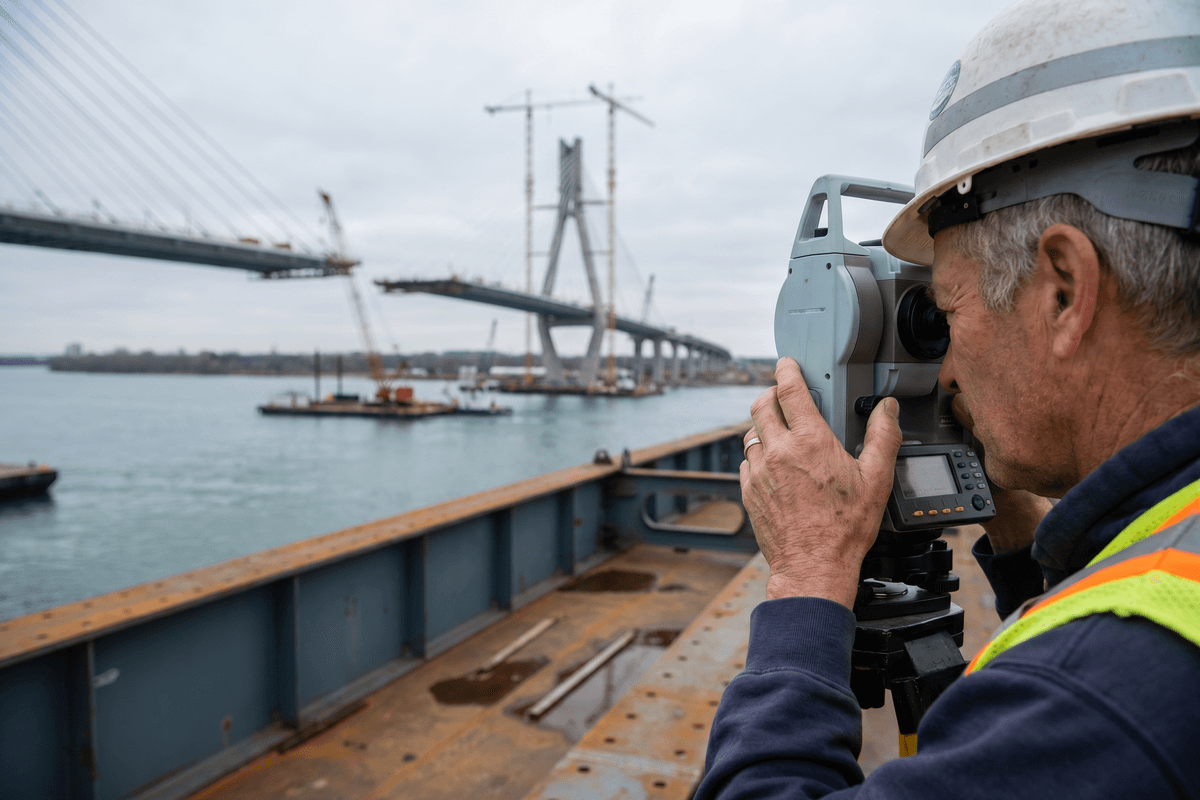
"The closure pour—the moment the Canadian and U.S. sides of the bridge deck finally met over the Detroit River—required millimeter-level precision. You are dealing with two massive cantilevered structures reacting independently to wind, thermal expansion, and dead loads. Bringing them together perfectly is the ultimate test of predictive modeling and real-time surveying."
Aerodynamic Stability and Wind Engineering
One of the most significant technical hurdles during construction was managing wind loads. During the cantilever phase, before the two halves of the deck were connected, the structure was highly vulnerable to aerodynamic instability. Canadian engineering teams utilized advanced computational fluid dynamics (CFD) and extensive wind tunnel testing to design temporary aerodynamic appendages and tuned mass dampers. These innovations ensured that the partially completed bridge could withstand severe crosswinds without suffering structural fatigue.
Bridging the Bi-National Regulatory Matrix
Engineering a physical bridge is only half the battle; engineering a unified project delivery framework across two sovereign nations is arguably the greater challenge. The Windsor-Detroit Bridge Authority (WDBA) and its private-sector partners had to seamlessly integrate Canadian Standards Association (CSA) codes with the American Association of State Highway and Transportation Officials (AASHTO) standards.
This dual-compliance mandate impacted everything from the metallurgical specifications of the rebar to the environmental mitigation strategies deployed on the riverbanks.
- Material Specifications: Concrete mix designs had to be formulated to meet the stringent freeze-thaw durability requirements of both jurisdictions while ensuring uniform curing times across the international boundary.
- Environmental Engineering: The project required intricate brownfield remediation on both sides of the border, utilizing advanced soil vapor extraction and groundwater isolation techniques to prevent historic industrial contaminants from leaching into the Detroit River during foundation drilling.
- Tolerances and QA/QC: Quality assurance teams implemented a unified digital inspection platform, allowing Canadian and U.S. engineers to sign off on structural milestones simultaneously, eliminating the friction of redundant cross-border approvals.
A Generational Leap in Trade Infrastructure
To truly understand the engineering triumph of the Gordie Howe International Bridge, it must be contextualized against the infrastructure it is designed to supplement and eventually supersede. The Ambassador Bridge, which has carried the bulk of the $1 billion in daily cross-border trade, is a nearly century-old suspension bridge that forces commercial traffic through local city streets.
The new crossing represents a paradigm shift in logistics engineering, offering direct highway-to-highway connectivity (Highway 401 in Ontario to Interstate 75 in Michigan).
| Feature | Ambassador Bridge (1929) | Gordie Howe Bridge (2026) |
|---|---|---|
| Structural Type | Suspension | Cable-Stayed |
| Main Span Length | 564 meters | 853 meters |
| Lanes | 4 (Narrow, undivided) | 6 (Wide, divided) + Multi-use path |
| Highway Integration | Local street access required | Direct 401-to-I75 connection |
| Port of Entry Size | Constrained urban footprint | Massive, modern plazas (130 acres CA / 167 acres US) |
The Port of Entry: A Masterclass in Civil Engineering
While the bridge span captures the public's imagination, the Ports of Entry (POE) on both sides are engineering marvels in their own right. The Canadian POE spans 130 acres and is built on a foundation of highly engineered fill and extensive subsurface drainage networks. Designing a facility capable of processing thousands of heavy commercial vehicles daily required innovative pavement engineering to prevent rutting and degradation under constant, high-tonnage static loads.
Furthermore, the facilities are designed with a heavy emphasis on sustainable engineering, incorporating LEED Silver standards, extensive green roofs, and stormwater management systems that filter runoff before it reaches the Detroit River watershed.
Looking Forward: The Legacy for Canadian Engineering
The June 15, 2026, opening of the Gordie Howe International Bridge is not an endpoint; it is a catalyst. For Canadian engineering firms, the intellectual property, project management frameworks, and technical innovations developed over the past decade of construction are now highly exportable assets.
The project proves that public-private partnerships (P3), when structured with realistic risk-transfer mechanisms and integrated project delivery principles, can successfully execute mega-infrastructure. As Canada looks to modernize its internal trade corridors, expand its northern infrastructure, and harden its coastal assets against climate change, the lessons learned over the Detroit River will be invaluable.
The millimeter-perfect connection of the Gordie Howe deck stands as a testament to what Canadian engineering can achieve. It reminds the industry that while the scale of our ambitions may grow, success will always rely on the unyielding precision of our execution.