Leverage the latest PHIUS standards to design high-performance, net-zero buildings that deliver exceptional durability, health, and energy resilience.
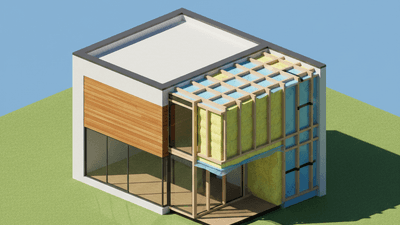
This six-hour course provides a comprehensive understanding of the Passive House Standard and focuses on its design and construction. The course explores the principles of passive design, architectural elements, and mechanical systems, along with strategies for optimizing energy performance.
The course also examines certification criteria, building codes, and standards related to passive house and energy-efficient design.
Through a blend of building science theory and practical application, professionals will learn how to optimize the building envelope to manage heat, air, and moisture effectively. The content covers the evolution of Passive House from its origins to the specific requirements of North American climate zones, moving through the critical components of the "perfect wall," the elimination of thermal bridges, and the science behind airtight construction. Instructors also provide detailed insights into mechanical system integration and the financial viability of high-performance builds.
This course covers the following key topics:
Ideal for architects, engineers, builders, and energy consultants, this course provides the technical knowledge necessary to design durable, healthy, and resilient structures that meet the newest Passive House standards.

Online Courses for Engineers
HalfMoon Education is a nonprofit continuing education provider offering live webinars and on-demand courses for engineers, architects, landscape architects, land surveyors, attorneys, paralegals, accountants and others. Since 1996, we’ve helped thousands of professionals nationwide stay current with industry standards and codes, earn CE hours, and advance their expertise through practical, expert-led learning experiences. Learn more about us at: www.halfmoonseminars.org
President, RE:source Design, LLC
Paul Westbrook designed his own solar home in north Texas in 1996, which won the Energy Value Housing Award for Innovative Design (https://enerjazz.com/house). It still ranks as one of the most efficient homes in Texas. While serving as Sustainable Development Manager at Texas Instruments International Facilities, Mr. Westbrook was the LEED AP for the 1.1 million square foot Texas Instruments factory, which was the first LEED Gold semiconductor factory in the world. He led the effort to improve the energy and water efficiency of TI’s 20 million square feet of existing global facilities. They were able to double the company’s energy and water efficiency in less than 10 years. In 2012, Mr. Westbrook was named a Senior Fellow for the US State Department’s Energy and Climate Partnership of the Americas program. He visited Honduras, Bolivia, Colombia, and Peru where he worked with governments, universities, and industry on efficiency and renewable energy. Mr. Westbrook received his B.S. degree in mechanical engineering from Louisiana State University, Baton Rouge, LA in 1982.
Certified Passive House Consultant and Owner of DwellGreen
Mr. Taylor is a certified Passive House consultant and Passive House rater. He is a HERS Rater and is certified by Energy Star, DOE Zero Energy Ready Home, IECC, and BPI. Mr. Taylor has served on the ANSI/RESNET National Committee for Water Efficiency, on the Environmental Committee for the town of Fairview, Texas, and as a project manager for large commercial data centers. This is a second career after the US Navy, a computer science degree, and 35 years in the computer services industry.
Founder and Principal of Peel Passive House Consulting
Mr. Peel is a renowned expert in the field of Passive House buildings. He is the founder and principal of Peel Passive House Consulting, a consulting firm that specializes in supporting the design and construction of high-performance, low-carbon buildings. Andrew has over 15 years of experience in the field and is an accredited Passive House certifier, consultant, and trainer. Andrew's passion for sustainable building began early in his career, and he has been dedicated to promoting energy efficiency and sustainability ever since. He has worked on a wide range of projects, including residential homes, multi-family dwellings, and commercial buildings, all with the aim of improving occupant quality of life, reducing energy consumption, and minimizing environmental impact. As a certified Passive House consultant, Andrew is well-versed in the principles of energy-efficient design and construction. He has a deep understanding of building science and can apply this knowledge to create buildings that are not only energy-efficient but also comfortable and healthy for their occupants. Andrew is also an active member of the sustainable building community, regularly attending conferences and events to stay up-to-date on the latest developments and innovations in the field. He is committed to educating others about the benefits of sustainable building and is always eager to share his expertise with clients, colleagues, and industry partners. With his passion, expertise, and commitment to sustainability, he is a leading figure in the industry and a valuable asset to any project.
