In this course you will learn about the basic construction of shell and tube and plate type heat exchangers and about counter flow, parallel flow, and cross flow patterns of flow.
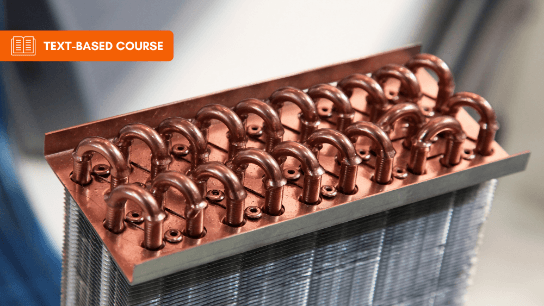
Heat exchangers are used to heat one fluid with a hotter fluid, to cool a fluid with a colder fluid, to condense a gaseous fluid with a colder fluid, or to boil a liquid with a hotter fluid. In this course you will learn about the basic construction of shell and tube and plate type heat exchangers and about counter flow, parallel flow, and cross flow patterns of flow. The heat transfer equation is introduced along with the log mean temperature difference and the overall heat transfer coefficient. The meaning of multi-pass and regenerative heat exchangers is covered and several common heat exchanger applications are discussed.
Topics: Be familiar with the parts of/general construction of shell, tube, and plate type heat exchangers Be able to differentiate among parallel flow, counter flow and cross-flow heat exchangers Be able to differentiate between single-pass and multi-pass heat exchangers Be able to differentiate between regenerative and non-regenerative heat exchangers. Know the meanings of the terms hotwell and condensate depression.
Intended Audience: primarily for mechanical, chemical, nuclear and industrial engineers, but would be of interest to any engineer wanting a review of heat exchanger basics. Someone completing this course will gain knowledge about the types and flow patterns of heat exchangers and about some of their applications.
Publication Source: US Dept. of Energy

Dr. Harlan Bengtson is an online PDH course provider of continuing education courses for professional engineers. Dr. Bengtson is a graduate of Iowa State University with B.S. and M.S. degrees and of the University of Colorado with a PhD. He is a licensed Professional Engineer in Missouri. Dr. Bengtson has spent 30 years in engineering education in teaching and administrative positions, including six years as Dean of Engineering at Southern Illinois University Edwardsville. Dr. Harlan H. Bengtson, PE 33 Grainey Drive Glen Carbon, IL 62034 Phone: (618) 406-6892 E-mail: hnkbengtson@yahoo.com PROFESSIONAL PROFILE Dr. Bengtson is a graduate of Iowa State University with B.S. and M.S. degrees and of the University of Colorado with a PhD. He is a licensed Professional Engineer in Missouri. He has spent 30 years in engineering education in teaching and administrative positions, including six years as Dean of Engineering at Southern Illinois University Edwardsville. His areas of expertise are environmental engineering, hydrology and hydraulics, engineering science and renewable energy systems. He has done regular consulting work while holding the academic positions. Prior to entering academia, Dr. Bengtson worked for Minnesota Mining & Manufacturing as a Product Development Engineer and for E. I. duPont deNemours as a Process Development Engineer. Dr. Bengtson has authored numerous publications, presentations and technical reports. He is currently active as a freelance technical writer, author of continuing education courses for Professional Engineers, and is the founder of www.engineeringexceltemplates.com and www.EngineeringExcelSpreadsheets.com, sites with the objective of providing inexpensive, easy to use Excel spreadsheets for a variety of engineering calculations.
