Principles and Applications of Differential Relays.
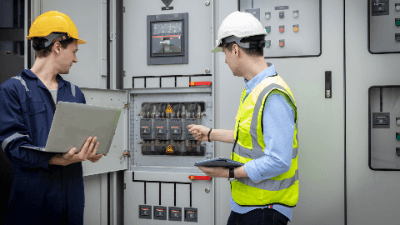
This course provides a comprehensive overview of differential protection in bulk electrical systems with distributed generation. Participants will delve into the principles and algorithms of differential relays, gaining insights into their critical role in ensuring system reliability and protection. The course covers various types of differential protection, including percentage differential relays, traveling wave relays, and ground fault protection. Detailed explanations of operational characteristics, settings, and coordination are provided, along with practical examples and real-world applications.
Key topics include the measurement and analysis of phase input and output, the principles of zero currents, and the importance of restraint current in dictating relay trips. Participants will explore the operational characteristics of various differential relays, including percentage differential relays, phase comparison percentage differential relays, and traveling wave relays. The course also covers the use of differential relays in protecting transformers, bus bars, generators, and large motors.
By the end of the course, participants will have a solid understanding of how to implement and manage differential protection relays to maintain efficient and safe electrical systems. They will gain practical skills in configuring and coordinating differential relays, analyzing their performance, and applying differential protection techniques to various electrical system components. This course is ideal for electrical engineers, system operators, and technical professionals involved in the design, operation, and maintenance of electrical systems with distributed generation.
35 years of Power Engineering & Control. Specialized in power, control, automation, instrumentation, nuclear. My name is Eduard Loiczli, Doctor Engineer in Electrical Engineering. I started programming Rockwell PLC's in 1991 and since then I have programmed and integrated many Automation Systems which required motion control, automation HMI Control and complex multitasking. I've also taught at many reputable schools. For all who are looking to learn fast and in depth Rockwell Automation, this introductory course is one in a series of four courses to launch you into a better understanding of Automation and Control. Email: eduard.loiczli@apcacademy.ca
