This course addresses the design and cost of wet scrubbers for control of PM10 and PM2.5. (PM10 as particle matter having a nominal aerodynamic diameter of 10 micrometer (μm) or less.
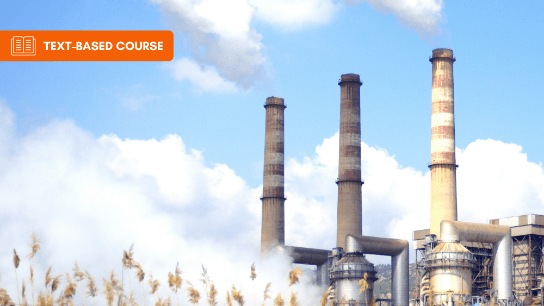
A wet scrubber is an air pollution control device that removes PM and acid gases from waste gas streams of stationary point sources. The pollutants are removed primarily through the impaction, diffusion, interception and/or absorption of the pollutant onto droplets of liquid. The liquid containing the pollutant is then collected for disposal. There are numerous types of wet scrubbers which remove both acid gas and particulate matter (PM).
This course addresses the design and cost of wet scrubbers for control of PM10 and PM2.5. (PM10 as particle matter having a nominal aerodynamic diameter of 10 micrometer (μm) or less. (PM2.5 is defined as PM less than or equal to 2.5μm in aerodynamic diameter. In general, “coarse PM” refers to PM10 while “fine” PM refers to PM2.5.)
Topics: Introduction to Wet Scrubber Systems Process Description Capture Mechanisms Scrubber Types Spray, Cyclonic Spray, and Tray Towers Dynamic, Venturi, and Orifice Scrubbers Other Designs Configuration and Operation of Venturi Scrubbers Liquid Storage and Delivery System Liquid Injection System Collection Chamber and Mist Eliminator Waste Liquid Collection and Disposal Auxiliary Equipment Design Parameters, and System Performance Liquid-to-Gas Ratio Velocity and Pressure Drop Particle Size Distribution and Loading Waste Gas Flow Rate, Temperature, and Humidity Residence Time Droplet Size System Design PM Distribution and Loading Collection Efficiency Waste Gas Properties Psychrometric Chart
Intended Audience: This course is intended for Environmental, Mechanical, Construction, Civil, Electrical, and other engineers whose job description requires a general knowledge of air quality control of airborne particulate matter.
Publication Source: Environmental Protection Agency

Dr. Harlan Bengtson is an online PDH course provider of continuing education courses for professional engineers. Dr. Bengtson is a graduate of Iowa State University with B.S. and M.S. degrees and of the University of Colorado with a PhD. He is a licensed Professional Engineer in Missouri. Dr. Bengtson has spent 30 years in engineering education in teaching and administrative positions, including six years as Dean of Engineering at Southern Illinois University Edwardsville. Dr. Harlan H. Bengtson, PE 33 Grainey Drive Glen Carbon, IL 62034 Phone: (618) 406-6892 E-mail: hnkbengtson@yahoo.com PROFESSIONAL PROFILE Dr. Bengtson is a graduate of Iowa State University with B.S. and M.S. degrees and of the University of Colorado with a PhD. He is a licensed Professional Engineer in Missouri. He has spent 30 years in engineering education in teaching and administrative positions, including six years as Dean of Engineering at Southern Illinois University Edwardsville. His areas of expertise are environmental engineering, hydrology and hydraulics, engineering science and renewable energy systems. He has done regular consulting work while holding the academic positions. Prior to entering academia, Dr. Bengtson worked for Minnesota Mining & Manufacturing as a Product Development Engineer and for E. I. duPont deNemours as a Process Development Engineer. Dr. Bengtson has authored numerous publications, presentations and technical reports. He is currently active as a freelance technical writer, author of continuing education courses for Professional Engineers, and is the founder of www.engineeringexceltemplates.com and www.EngineeringExcelSpreadsheets.com, sites with the objective of providing inexpensive, easy to use Excel spreadsheets for a variety of engineering calculations.
